
In this article8 sections
- 01What counts as a standardized instrument for 96127
- 02How many units of 96127 you can bill per visit, and how often
- 03Billing 96127 beside an office visit
- 04Who pays for 96127: Medicare, Medicaid and commercial plans
- 05Where 96127 ends: 96160, G0444 and psychological testing
- 0696127 on therapy and psychiatry days
- 07What the note must show for each unit
- 08Frequently asked questions
Key takeaways
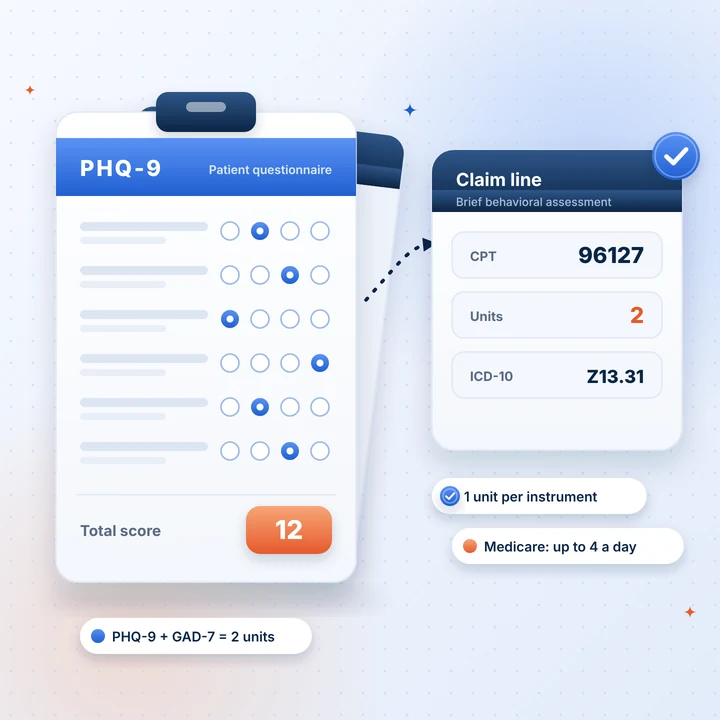
- One unit per instrument: a PHQ-9 and a GAD-7 at the same visit are 2 units of 96127.
- 4 units a day under Medicare: the practitioner limit rose from 3 to 4 per date of service on October 1, 2026.
- $5.01 per unit: the 2026 Medicare national payment, before locality adjustment.
- Medicare’s limit is per day, not per year: any yearly cap comes from the payer or a Medicare contractor’s local policy.
- Medicare’s annual depression screen is G0444: once every 12 months, and never on the day of the first annual wellness visit or the Welcome to Medicare visit.
- 96160 is a health risk assessment: for a depression or ADHD scale, 96127 is the more specific code.
A patient fills out a PHQ-9 before the visit, and the clinician reviews the score with them. That screen has its own code, CPT 96127. It pays a small amount per form, so counting each form correctly matters. This guide covers how units are counted, how often the code can be billed, and when another code applies instead.
What counts as a standardized instrument for 96127
96127 covers one brief emotional or behavioral instrument that is given, scored and documented. Examples include the PHQ-9, GAD-7, a Vanderbilt ADHD scale and the CRAFFT. A standardized instrument is a validated questionnaire with a fixed scoring method. A list of questions the clinician writes does not qualify.
The code’s own examples are a depression inventory and an ADHD rating scale. Anxiety, substance use and suicide-risk screens fit the same description when they use a validated tool.
Clinical staff, such as a medical assistant or nurse, can hand out and score the form. The physician or other qualified health care professional then reviews the score. That review, and any decision it leads to, belongs to the visit itself rather than to 96127. The American Academy of Family Physicians explains this.
How many units of 96127 you can bill per visit, and how often
Bill one unit per instrument, up to 4 units per date of service under Medicare’s medically unlikely edit for 96127. The limit rose from 3 to 4 on October 1, 2026, which is why older pages still say 3.
Units per visit
A PHQ-9 and a GAD-7 given at one visit are 2 units. Report them on one claim line with 2 in the units field. Some payers read two lines of the same code as a duplicate, so one line with the full count is the safer default.
If the units on one date go over 4, Medicare denies every unit of the code on that claim. Recovering them takes an appeal with documentation, not a modifier. Commercial and Medicaid plans set their own daily caps, and some allow fewer units than Medicare.
Unit math
How 96127 units add up on one date of service
One unit per standardized instrument, reported on one claim line. Medicare pays about $5.01 a unit in 2026, before locality.
Limit rose from 3 to 4 on October 1, 2026Commercial and Medicaid caps can be lower
How often you can bill 96127 per year
The code describes a single assessment, and Medicare’s national edit carries no annual cap. Some Medicare contractors set their own limits in local policy. A patient can be screened at more than one visit in a year, as long as each screen is clinically justified and documented. Commercial and Medicaid plans may still limit screens per year or tie them to well visits. Check the policy before scheduling repeat screens to monitor a condition.
When a 96127 line is denied for units or bundling, Northgate Billing works the denial and files the appeal inside the practice’s own software.
Small claims like these are easy to lose track of when billing stays in-house. Read next: Is outsourcing medical billing a good idea? When it is, and when in-house is better
Billing 96127 beside an office visit
Report 96127 on its own claim line after the E/M code. It is a separate service, not part of the visit.
Many payers want modifier 25 on the visit code to show that the visit was separate from the screen. Whether a payer requires it is set in that payer’s policy, so check before the claim goes out.
96127 is not an add-on code, so it can stand on a claim with no visit code. That happens when the screen is the whole encounter, such as a follow-up PHQ-9 given by a nurse. Whether the payer pays it alone depends on its policy and on its rules for services that staff perform.
Who pays for 96127: Medicare, Medicaid and commercial plans
Medicare pays $5.01 per unit nationally in 2026, per the CMS Physician Fee Schedule, when the assessment is reasonable and necessary. Medicaid and commercial plans set their own rates. Medicare’s figure moves up or down with the practice’s locality.
Medicare does not pay 96127 for a routine yearly depression screen in primary care. That screen is billed as G0444 under National Coverage Determination 210.9.
Commercial payers commonly cover 96127 in primary care.
The diagnosis code follows the reason for the screen:
- Z13.31 for a depression screen.
- Z13.39 for other mental health and behavioral screens.
- The condition’s own code when the screen monitors a known diagnosis.
96127 is on Medicare’s list of telehealth services, so a screen completed during a video visit is billed under the same rules.
Where 96127 ends: 96160, G0444 and psychological testing
Use 96127 for an emotional or behavioral instrument, 96160 for a health risk assessment about the patient, and 96161 for a screen of the caregiver.
| Code | What it reports, with an example instrument | Units, frequency and Medicare 2026 national payment |
|---|---|---|
| 96127 | Brief emotional or behavioral assessment, such as a PHQ-9, GAD-7 or Vanderbilt scale | 1 per instrument, up to 4 per day; $5.01 per unit |
| 96160 | Health risk assessment focused on the patient, such as a health risk appraisal or Mini Nutritional Assessment | 1 per instrument; $3.01 per unit |
| 96161 | Health risk assessment of the caregiver, for the patient’s benefit, such as the Edinburgh Postnatal Depression Scale given to a parent at the infant’s visit | 1 per instrument; $3.34 per unit |
| G0444 | Medicare annual depression screening, 5 to 15 minutes, with any validated depression tool such as the PHQ-9 | Once every 12 months, not with the first annual wellness visit or the Welcome to Medicare visit; $18.70 |
Some payers still ask for 96160 on depression screens, so follow the payer’s policy there. G0444 has its own same-day limit. Medicare’s correct coding manual does not allow it beside a visit that addresses depression symptoms.
A full psychological evaluation is testing, not screening, and uses the psychological testing codes 96130 to 96139. When a positive screen leads to counseling at the same visit, that time is billed with preventive counseling codes 99401 to 99404.
96127 on therapy and psychiatry days
Whether 96127 pays on the same day as 90791 or a psychotherapy session depends on the payer. Some payers count the screen as part of that service.
Medicare’s correct coding manual treats ongoing evaluation as part of psychotherapy, so 90791 is not billed with a therapy session on the same day. The session codes themselves are covered in mental health CPT codes such as 90791 and 90837.
A psychiatric medication visit billed with an E/M code is different. A screen given before that visit follows the office-visit rules above.
Licensed counselors and therapists should confirm their own billing eligibility first. Medicare’s rules for these clinicians changed in 2024, as set out in which therapists can bill Medicare.
What the note must show for each unit
Each unit needs five elements in the note, the same ones the AAFP lists for any structured screen:
- Date and instrument: the tool by name, such as PHQ-9, not “depression screen”.
- Score: the number the tool produces.
- Who administered it: name and credential, including staff.
- Interpretation: what the score means for this patient.
- Follow-up: any referral, treatment change or repeat screen.
An example note line: “PHQ-9 given by MA, score 12. Reviewed with patient; moderate symptoms. Referral to behavioral health placed.” Two instruments need two entries like this, one per unit billed.
Conclusion: getting paid for every screen you score
96127 pays per instrument, so the revenue depends on counting units correctly, staying inside each payer’s limits and documenting every score. At about $5 a unit, a practice that screens only now and then may not need to change anything.
Practices that screen at most visits see the gap faster, especially in mental health billing. Our medical billing services page explains how the service works. Northgate Billing signs a Business Associate Agreement under 45 CFR 164.504(e) before it accesses any record, including screening scores. The harder question is whether claims this small are worth keeping in-house at all.
Frequently asked questions
Can cpt 99214 and 96127 be billed together?
Yes. 99214 is the office visit and 96127 is the screen, so each goes on its own claim line. Many payers want modifier 25 on 99214 to show the visit was separate from the screen. The note must show the screen’s score and the clinician’s interpretation. Bill 96127 with one unit for each instrument given.
What is the 96127 CPT code?
96127 is the CPT code for a brief emotional or behavioral assessment with a standardized instrument, including scoring and documentation. Common examples are the PHQ-9 for depression, the GAD-7 for anxiety and Vanderbilt scales for ADHD. Staff can give and score the form, and the clinician reviews it. Each instrument counts as one unit of 96127.
What is the difference between CPT code 96127 and 96160?
96127 reports a brief emotional or behavioral assessment, such as a depression or ADHD scale. 96160 reports a health risk assessment about the patient, such as a health risk appraisal. Some payers still list 96160 for depression screens, so check the policy. For a tool that screens mood, anxiety, attention or substance use, 96127 is the more specific code.
What is the difference between the CPT codes G0444 and 96127?
G0444 is Medicare’s annual depression screening, covered once every 12 months in primary care. It cannot share a day with the first annual wellness visit or the Welcome to Medicare visit. 96127 is a CPT code that Medicare and most other payers accept for any brief emotional or behavioral instrument. For a Medicare patient’s routine yearly depression screen, use G0444. For other screens and known symptoms, use 96127.
Can CPT code 96127 be billed alone?
Yes. 96127 is not an add-on code, so it can appear on a claim without a visit code. That happens when the screen is the whole encounter, such as a follow-up PHQ-9 given by a nurse. Payers differ on whether they pay it alone and on their rules for services staff perform. Check the policy before billing 96127 on its own.
Does insurance pay for 96127?
Commercial plans and Medicaid programs commonly pay for 96127, and Medicare pays when the assessment is reasonable and necessary. Rates are low: Medicare pays about $5.01 per unit nationally in 2026. Limits on units per day and screens per year vary by plan. Confirm coverage and limits with each payer before billing 96127.
How often can 96127 be billed?
Neither CPT nor Medicare’s national edit sets a yearly limit, so 96127 can be billed at each visit where a screen is clinically justified. Some Medicare contractors set their own limits in local policy. Per day, Medicare allows up to 4 units, one per instrument. Commercial and Medicaid plans may cap screens per year or tie them to well visits. Check each payer’s frequency rule for 96127.
Is 96127 billable to Medicare?
Yes. Medicare pays 96127 at about $5.01 per unit nationally in 2026, up to 4 units per date of service. The routine annual depression screen for Medicare patients is billed as G0444 instead. Use 96127 for other instruments, and for screens that monitor symptoms the patient already has.
What are the CPT 96127 CMS guidelines for billing?
CMS pays per standardized instrument, up to 4 units per date of service under its medically unlikely edit. Medicare covers a routine yearly depression screen through G0444 rather than this code. Correct coding rules also bar G0444 beside a visit that addresses depression symptoms. Document the tool, score and interpretation for each unit of 96127.
Should these claims stay in-house?
Codes worth a few dollars a unit show whether in-house billing pays for itself.
Read the guideOr see how medical billing services work.

Written by
Orvella Denvik
Senior Account Lead, Northgate Billing
This article is general billing information, not legal or coding advice for a specific claim. CPT is a registered trademark of the American Medical Association. Payer rules change; confirm current policy before billing.