
In this article7 sections
- 01Core chiropractic CPT code categories
- 02What Medicare covers when a chiropractor bills
- 03The AT modifier, maintenance care and GA or GZ
- 04What Medicare checks on every chiropractic claim
- 05How do I get a list of CPT codes?
- 06Conclusion: chiropractic codes and what Medicare pays
- 07Frequently asked questions
Key takeaways
- Regions, not adjustments: 3 adjustments in the lumbar spine count as 1 region, so the visit is 98940.
- Exact segments: the note names each segment treated, such as C5 or L4, not just the region.
- AT is not proof: the note must show the patient is still improving, or Medicare can deny the visit on review.
- Not covered from a chiropractor: 98943, office visits, X-rays, therapy and traction; if submitted, they carry GY, and therapy adds GP.
- Diagnosis pairs: the subluxation level (M99.00 to M99.05) goes first and the condition second, 1 pair per region treated.
- Start date: every Medicare claim carries the date the current course of treatment began.
A chiropractic practice bills Medicare and commercial plans from a single short list of chiropractic CPT codes. The codes stay the same from payer to payer. What gets paid does not. A commercial plan may pay for an adjustment, an exam and a therapy code on the same visit. Medicare may pay for 1 line on that claim, or none, depending on 2 letters added to the code.
Leave those letters off, and the denial looks like a coding error when the code itself was right. This guide covers the codes chiropractors bill most, which of them Medicare pays, and what the AT modifier changes on each claim.
Core chiropractic CPT code categories
Chiropractic CPT codes fall into 3 groups: manipulation (98940 to 98943), office visits (evaluation and management, or E/M) and physical medicine codes. Manipulation is the core of almost every visit. Whether the other 2 pay depends on the payer.
Manipulation codes 98940 to 98943
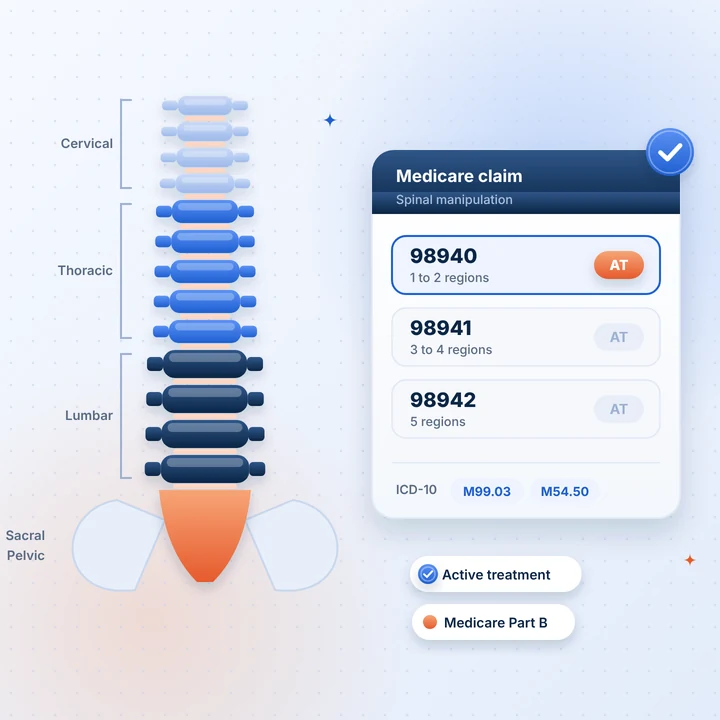
The manipulation code depends on how many regions were treated, not how many adjustments were made. CPT recognizes 5 spinal regions: cervical (including the atlanto-occipital joint), thoracic (including the costovertebral and costotransverse joints), lumbar, sacral and pelvic (the sacroiliac joint).
98940 covers 1 to 2 spinal regions, 98941 covers 3 to 4, and 98942 covers all 5. 98943 covers extraspinal regions: the head, the extremities, the rib cage and the abdomen.
In the lumbar spine, 3 adjustments are still 1 region, so the visit is 98940. With 1 adjustment each to the neck, mid back and low back, the visit covers 3 regions and is 98941. The note has to name the exact segments treated, such as C5, C6 or L4, because naming only the region is not enough.
Office visits
A chiropractor can bill an E/M visit (99202 to 99215) on the same day as manipulation. The visit has to be separately identifiable, such as a new patient exam or a new complaint.
Physical medicine codes
Common therapy and modality codes are 97110 (therapeutic exercise), 97112 (neuromuscular re-education), 97140 (manual therapy), 97530 (therapeutic activities) and 97012 (mechanical traction). Coverage varies by plan and by the state’s chiropractic scope of practice. Units follow the same timed and untimed therapy code rules that apply to a physical therapist.
What Medicare covers when a chiropractor bills
Original Medicare (Part B) covers 3 codes from a chiropractor: 98940, 98941 and 98942, for manual manipulation of the spine to correct a subluxation. The Medicare Benefit Policy Manual, chapter 15, section 240, limits the chiropractic benefit to that single service. Medicare Advantage plans may add chiropractic benefits of their own.
A subluxation, in Medicare’s terms, is a spinal segment whose alignment, movement or function is altered while the joint surfaces still touch. A chiropractor may use a hand-held manual device for the manipulation, but Medicare pays nothing extra for it.
Everything else a chiropractor orders or furnishes falls outside the benefit, including manipulation outside the spine (98943). A Medicare Administrative Contractor (MAC), the company that processes Part B claims in each region, enforces this rule on every claim. Noridian, the MAC for Jurisdiction F (10 western states), says Medicare does not pay a chiropractor for office visits, X-rays or physical therapy. An X-ray can still be used to document the subluxation.
None of this applies until each chiropractor is individually enrolled in Medicare, the work insurance credentialing services cover. Payer visit caps and enrollment steps are explained in chiropractic credentialing.
Medical billing from Northgate Billing checks each chiropractic Medicare claim for AT, the subluxation diagnosis and the start date before submission.
| Code | What it describes | Regions | Medicare, billed by a chiropractor | Medicare modifier |
|---|---|---|---|---|
| 98940 | Spinal manipulation | 1 to 2 | Covered for subluxation, active treatment | AT; GA or GZ if maintenance |
| 98941 | Spinal manipulation | 3 to 4 | Covered for subluxation, active treatment | AT; GA or GZ if maintenance |
| 98942 | Spinal manipulation | 5 | Covered for subluxation, active treatment | AT; GA or GZ if maintenance |
| 98943 | Extraspinal manipulation | 1 or more extraspinal | Not covered | GY if submitted |
| 99202 to 99215 | Office visits (E/M) | n/a | Not covered | GY if submitted |
| 97012, 97110, 97112, 97140, 97530 | Therapy and traction | n/a | Not covered | GY + GP if submitted |
| 72040, 72100, 72170 (examples) | Spine and pelvis X-rays | n/a | Not covered | GY if submitted |
Commercial plans set their own rules. Many pay 98943, office visits and therapy codes from a chiropractor, often with a visit cap or prior authorization. Check each plan’s chiropractic policy before the first visit.
Wondering whether to keep chiropractic billing in-house? Read: Is outsourcing medical billing a good idea? When it is, and when in-house is better
Modifier check
Which modifier a chiropractic Medicare line takes
Two questions settle it on every visit. The note has to back the answer.
- 1Is the code 98940, 98941 or 98942, for a subluxation?No: not covered from a chiropractor. GY if submitted, plus GP on therapy lines
- 2Is the patient still improving, as the note shows?No: maintenance care. Drop AT and use GA or GZ below
Maintenance care
The AT modifier, maintenance care and GA or GZ
The chiropractic AT modifier tells Medicare a 98940 to 98942 visit is active treatment: the patient is still improving. Without AT, the MAC treats the visit as maintenance care and denies it.
When the AT modifier applies
AT goes on 98940, 98941 or 98942 when the visit is active or corrective treatment of an acute or chronic subluxation. The Medicare Claims Processing Manual, chapter 12, section 220, sets the billing rule. AT is never used on 98943 or on any other code.
The modifier alone does not make the visit medically necessary. Noridian notes that the MAC can still deny it after review, so the treatment note has to show the progress.
When GA or GZ replaces AT
Care becomes maintenance once the patient stops improving and further progress cannot be expected. From that visit on, the claim drops AT and carries 1 of 2 modifiers:
- GA: the patient signed an Advance Beneficiary Notice of Noncoverage (ABN) before the visit. Medicare denies the line, and the patient can be billed.
- GZ: no signed ABN is on file. Medicare denies the line, and the practice generally cannot bill the patient.
The form itself, its options and its timing are covered in what an ABN is and when it is required.
MACs differ on 1 point. Noridian says not to report AT and GA on the same claim, or AT with GX, GY or GZ on the same line. WPS, the MAC for Iowa, Kansas, Missouri, Nebraska, Indiana and Michigan, describes adding GA to an AT visit that is likely to be denied. Check which rule your MAC follows before combining them.
Other modifiers also show up on chiropractic claims. Modifier 25 goes on a same-day office visit, and 59 or XS marks a distinct procedure. Neither changes what Medicare pays a chiropractor. The rules for both are in how modifiers 25 and 59 work.
What Medicare checks on every chiropractic claim
Medicare checks 4 things on a chiropractic claim: the subluxation level, the condition treated, the date treatment began and the modifier.
- Primary diagnosis: the precise level of the subluxation, coded as segmental and somatic dysfunction of the region treated (M99.00 to M99.05).
- Secondary diagnosis: the condition that needs the treatment, such as low back pain (M54.50).
- Initiation date: when the current course of treatment began, repeated on every claim in that course.
- Modifier: AT, GA or GZ, matched to the care given.
A lumbar visit, for example, bills 98940 with AT, M99.03 first and M54.50 second.
Each region treated needs its own primary and secondary pair. Noridian’s documentation guidelines say that when 3 to 5 regions are treated, the 2 most significant pairs go on the claim and the rest stay in the note.
How do I get a list of CPT codes?
The full CPT code list comes from the American Medical Association, which owns the code set and publishes it each year. What Medicare pays a chiropractor for is set out in your MAC’s chiropractic billing article. Search for it by state in the CMS Medicare Coverage Database.
The AMA’s CPT pages cover the codebook and licensed data files. New and changed codes for the year are listed in the 2026 fee schedule changes.
Conclusion: chiropractic codes and what Medicare pays
Most chiropractic claims rest on 3 codes and 1 modifier. The codes are the easy part; the modifier, the diagnosis order and the note decide whether Medicare pays.
A practice with few Medicare patients and a steady AT and ABN routine may never need outside help with these codes. Where AT, ABN or diagnosis-order denials keep coming back, medical billing services with chiropractic billing support can take that work on. Northgate Billing signs a Business Associate Agreement under HIPAA, 45 CFR 164.504(e), before it opens a chiropractic practice’s claims. Getting visits paid is one job; filling the schedule is another, and the subject of chiropractic marketing ideas. The question that follows is whether billing should stay in-house at all.
Frequently asked questions
Is 97012 a chiropractic code?
97012 is mechanical traction, a physical medicine code rather than a chiropractic manipulation code. Chiropractors can bill it where the state’s scope of practice and the patient’s plan allow, and many commercial plans pay it. Medicare does not cover traction from a chiropractor.
What are the common chiropractic CPT codes in 2026?
The common codes are 98940, 98941 and 98942 for spinal manipulation by region count, and 98943 for extraspinal manipulation. Office visit codes 99202 to 99215 and therapy codes such as 97110, 97112, 97140 and 97012 come next, depending on the payer.
Is there a cheat sheet for chiropractic billing?
Yes. A useful cheat sheet lists each code, the regions it covers and whether Medicare pays it, which is what the table in this guide does. Pair it with the ICD-10 list in your MAC’s billing article. Together they cover code choice, diagnosis order and the AT modifier for most Medicare visits.
What CPT codes can chiropractors use?
Chiropractors can use any CPT code their state license covers and the payer accepts. That usually means 98940 to 98943, office visit codes, therapy and modality codes, and X-rays. Medicare is narrower and pays a chiropractor only for the 3 spinal manipulation codes.
What are the most common ICD-10 codes used by chiropractors?
For Medicare, the primary diagnosis is the subluxation level, coded M99.00 to M99.05 by region, and the secondary is the condition treated. Common secondary codes include M54.2 for neck pain, M54.50, M54.51 or M54.59 for low back pain, and M54.6 for thoracic pain. The old low back pain code, M54.5, is no longer valid.
Does Medicare require an X-ray for chiropractic claims?
No. A subluxation can be shown by X-ray or by physical exam. On exam, CMS requires 2 of 4 findings, known as PART: pain, asymmetry, range of motion abnormality and tissue tone, texture or temperature changes. At least 1 of the 2 must be asymmetry or range of motion. Either way, the findings must be in the record for each segment billed.
Can a chiropractor bill a Medicare patient for services Medicare does not cover?
Yes, for services Medicare excludes by law, such as office visits, X-rays and therapy from a chiropractor. The patient can be billed for them directly. If the patient asks for a Medicare claim anyway, it goes in with the GY modifier, and therapy lines also need a therapy modifier such as GP.
Should chiropractic billing stay in-house?
When outsourcing medical billing pays off, when in-house is better, and how to tell which fits your practice.
Read the guideOr start with a free billing audit.

Written by
Orvella Denvik
Senior Account Lead, Northgate Billing
This article is general information about Medicare and commercial billing rules as of November 2026. It is not legal or coding advice for a specific claim. Check your MAC’s current billing article before you submit.