
In this article5 sections
Key takeaways
- Medical necessity decides the payer. Biopsies, trauma care and impacted third molars are common medical-plan claims. Routine fillings and cleanings stay with dental.
- Medical claims use medical code sets. Procedures move from CDT to CPT or HCPCS, and every line needs an ICD-10-CM diagnosis.
- Medicare is the narrow exception. Since July 1, 2025, its dental claims need the KX modifier and an ICD-10 code.
- The chart carries the claim. Codes alone do not prove medical necessity; the notes, imaging and diagnosis do.
- Some dental plans send claims away. A biopsy is the common example: the dental plan refuses it and points to the medical plan.
- Appliances are equipment. Sleep apnea and jaw joint appliances take HCPCS codes as durable medical equipment.
A patient needs a biopsy, a splint for a painful jaw joint, or an appliance for sleep apnea. The dental plan either excludes it or caps it at an annual maximum the patient has already used. Most dental billing never leaves the dental plan, but this treatment may not have to stay there.
Medical insurance often pays for dental work when the problem is medical. The catch is that a medical claim speaks a different language: different codes, a different form and a different standard of proof. This guide covers how dental billing normally works and what changes on a medical claim. Then it answers the question that decides it: when can dental work go to medical insurance, and what does that claim need?
How does dental billing work?
Dental billing moves a treatment from the chair to payment in six steps. They are verification, coding, claim submission, payment posting, denial work and patient billing. Each step depends on the one before it, so an error at verification shows up later as a denial.
- Verify coverage. Confirm the plan is active and check benefits, waiting periods and the remaining annual maximum.
- Code the procedure. Dental plans expect CDT codes, the dental code set. A short reference to common CDT codes covers the ones most practices use.
- Submit the claim. Send it on the ADA claim form or its electronic version, with x-rays or narratives where the plan asks for them.
- Post the payment. Match the payment to the explanation of benefits and record any write-off.
- Work denials. Correct and resubmit rejected claims, and appeal denials the chart can support.
- Bill the patient. Send a statement for the balance the plan leaves to the patient.
The weak point is the annual maximum: once a patient reaches it, the dental plan pays nothing more until the next benefit year.
Dental vs. medical billing: what changes on the claim
Sending a claim to a medical plan changes four things: the codes, the form, the evidence and the benefit limit. The table sets them side by side.
| Element | Dental plan claim | Medical plan claim |
|---|---|---|
| Procedure codes | CDT | CPT or HCPCS (CDT where the payer allows) |
| Diagnosis codes | Often optional; fields exist on the 2024 ADA form | ICD-10-CM required, linked to each procedure line |
| Paper form | 2024 ADA Dental Claim Form | CMS-1500 |
| Electronic transaction | 837D | 837P |
| Evidence the payer expects | X-rays, periodontal charting, narratives | Chart notes showing medical necessity, imaging, physician referral where required |
| Benefit limit that bites | Annual maximum | Deductible and out-of-pocket rules |
The CMS-1500 is the standard professional claim form that medical payers use, and its fields differ from the ADA form. The CMS-1500 guide walks through it box by box.
Payment order matters too. When a patient has both a medical and a dental plan, the ADA’s guidance treats the medical plan as primary. The rules behind that are covered in primary vs. secondary insurance.
Once medical claims are part of the work, the next decision is who handles them: whether to outsource billing.
Cross-coding: which dental procedures medical insurance pays for
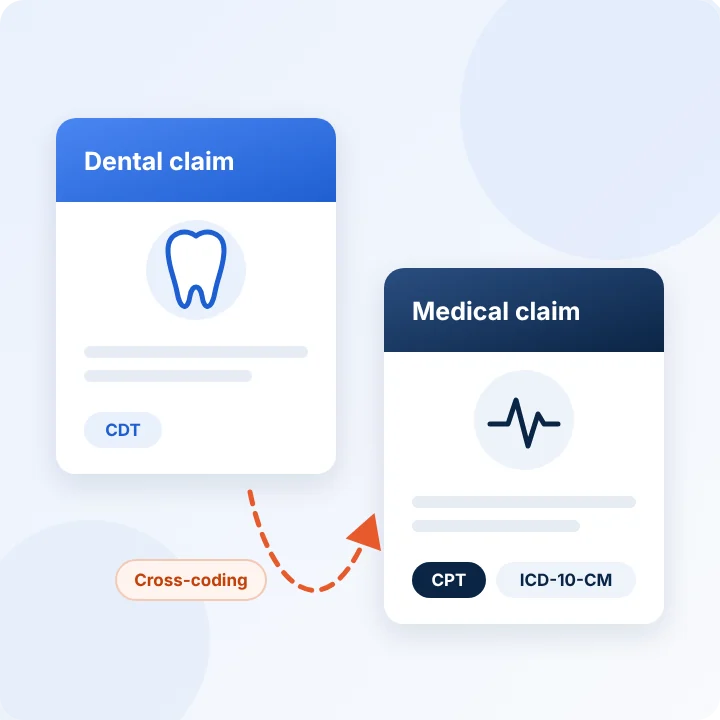
Cross-coding means billing a dental procedure to the patient’s medical plan. It works when the treatment is medically necessary or trauma-related, not routine dental care. Cleanings, fillings and crowns stay with the dental plan. Dental is one of the medical billing specialties where this split decides who pays.
The same procedure can be payable under one plan and excluded under another. Aetna’s medical policy, for example, covers removal of bone-impacted teeth under some plans only. The plan documents decide, so coverage is checked before the claim is built.
The coding rule is to report what was done, with the code that describes it most accurately, and only what the clinical notes support. For most procedures that is a CPT code, the set the AMA maintains. Where no CPT code describes the work, many medical payers accept the CDT code, so it is worth asking the payer first. Each line then carries an ICD-10-CM code that shows why the procedure was medically necessary.
Medical billing from Northgate Billing files medically necessary dental procedures to medical plans from provider-assigned codes, inside the practice’s own software.
Trauma and jaw fractures
Injury is the clearest case for a medical claim. Medical plans often pay to reduce facial bone and jaw fractures. Removing broken teeth to set a jaw fracture counts as part of that medical procedure. Many plans also pay to repair sound natural teeth damaged in an accident. Damage from biting or chewing is usually excluded, so the chart should record how the injury happened.
Biopsies and oral pathology
Biopsies are medical in nature, so dental plans typically refuse them and tell the practice to bill the medical plan. The same applies to removing cysts, tumors and other diseased tissue of the jaw. The pathology report supplies the diagnosis code the medical claim needs.
TMJ disorders
Jaw joint treatment is billable to medical plans, but coverage varies widely by plan. Treating a dislocated jaw joint is a common medical benefit, while other TMJ care depends on the plan’s terms. Jaw joint appliances count as durable medical equipment, so they take HCPCS codes rather than CDT.
Sleep apnea oral appliances
An oral appliance for obstructive sleep apnea is treated as a medical device, not dental care. A custom appliance is coded E0486 under the equipment benefit. The coverage policy for that code requires a physician’s diagnosis of sleep apnea. Practices that add sleep apnea care often promote it locally, which dental practice marketing covers.
What a medical payer needs before it pays a dental claim
The chart has to prove medical necessity, and medical payers look for five things in it. A claim with correct codes but a thin record is the one that comes back denied.
- Diagnosis. Recorded in the notes to the greatest specificity the findings allow.
- Clinical notes. They describe the symptoms, findings and why the treatment is medical rather than routine.
- Imaging. X-rays or scans that show the fracture, lesion or joint problem.
- Referral or letter of medical necessity. Some plans want a physician’s referral, or a letter linking the dental work to a medical condition.
- Prior authorization. Plans with precertification rules require approval before treatment, not after.
The dentist also has to be enrolled with the medical payer to be paid in-network. Those steps are covered in dental credentialing.
Decision path
Does this procedure go to the medical plan?
Four checks before a dental procedure is billed as medical. A no at any step stops the claim.
- 1Is the treatment medically necessary or trauma-related?No: routine care stays with the dental plan
- 2Does the chart show a diagnosis, notes and imaging?No: complete the record before filing
- 3Is the dentist enrolled with the medical payer?No: enroll with the payer to be paid in-network
- 4Are any required referral and prior authorization in place?No: get them before treatment, not after
Medicare’s rules are narrower. 42 CFR 411.15(i) excludes routine dental care, including extraction of an impacted tooth. Payment is allowed when dental work is inextricably linked to a covered treatment. Examples include organ transplants, cardiac valve replacement, cancer chemotherapy, head and neck cancer treatment and dialysis for end-stage renal disease. The record must show that the dentist and the treating physician coordinated care, such as through a referral. Since July 1, 2025, these claims need the KX modifier and an ICD-10 code, including on the 2024 ADA form. Attachments such as x-rays are not sent with the claim; the contractor asks in writing if it needs them, according to CMS.
Why cross-coded claims get denied
Most denials trace back to the record, not the code. The usual causes are a procedure line with no linked diagnosis, routine care billed as medical, or a missing referral or authorization. Some claims also go to the dental plan when the medical plan should have gone first. Each one can be spotted in the chart before filing.
Conclusion: billing dental work to medical insurance
Cross-coding pays when a practice regularly treats trauma, pathology, jaw joint problems or sleep apnea, and the chart proves the medical need. A practice that sees those cases rarely may find that medical enrollment and a second code set cost more than they return. For the wider picture, medical billing services covers how claims are filed and followed up, and insurance credentialing services covers payer enrollment.
Northgate Billing signs a Business Associate Agreement under 45 CFR 164.504(e) before it accesses any dental or medical record. Once medical claims are part of the work, the next question is whether that billing is better kept in-house or handed off.
Frequently asked questions
Is dental billing a good career?
It can be. Billing and coding work falls under the Bureau of Labor Statistics group of medical records specialists. Their median pay was $51,140 in May 2025, and 8% job growth is projected from 2025 to 2035. For a practice, the same skills are what to look for when hiring someone to bill dental work to medical plans.
Is dental billing hard to learn?
The dental side is learnable: CDT codes, the ADA claim form and dental plan rules. Medical claims take longer to master, because each procedure needs a diagnosis backed by the chart. For a practice, that medical layer is the part to plan training around, since it decides whether a cross-coded claim is paid.
Is it hard to be a billing specialist?
The work is detailed rather than difficult: checking codes against the chart, tracking payer rules and following up on unpaid claims. Accuracy and persistence matter more than speed. Cross-coding raises the bar, because the specialist works with two claim forms and two sets of payer rules for the same patient.
Do dental claims require ICD-10 diagnosis codes?
Many dental plans do not require them yet. The 2024 ADA claim form has fields for them, and some government programs make them mandatory. Where a plan accepts a diagnosis, adding one can shorten the narrative the claim needs. The code itself explains the reason for treatment.
Can medical insurance pay for dental implants?
Usually not for routine tooth replacement. Medical plans may pay for implants that are part of covered reconstruction, such as rebuilding a jaw after tumor removal. Some plans also cover teeth lost in an accident. Even then, the plan may pay to place the implant but not for the crown. When a plan does pay, the claim needs the same diagnosis and records as any other cross-coded procedure.
Is cross-coding dental procedures to medical insurance legal?
Yes, when the records support it. Cross-coding exists because some dental work is medical, such as a biopsy or a fractured jaw. Reporting cleanings or fillings as medical treatment, or a diagnosis the notes do not support, is misrepresentation. The claim form is a legal document, and the treating dentist is responsible for what it reports.
Can a patient ask the dentist to bill their medical insurance?
Yes. Requests come from patients and sometimes from the dental plan itself. The request does not change the outcome, though: the medical plan judges the claim on the chart, not on who asked. A patient’s request is a reason to check the medical plan’s terms, not a reason to change the codes.
Keep medical claims in-house, or hand them off?
See when outsourcing billing makes sense for a practice, and when keeping it in-house is the better call.
Read: should you outsource medical billing?Or see how medical billing services work.

Written by
Orvella Denvik
Senior Account Lead, Northgate Billing
This article is general information about billing and coding. Coverage depends on each patient’s plan documents and payer policies, which change. Check current payer rules before filing.