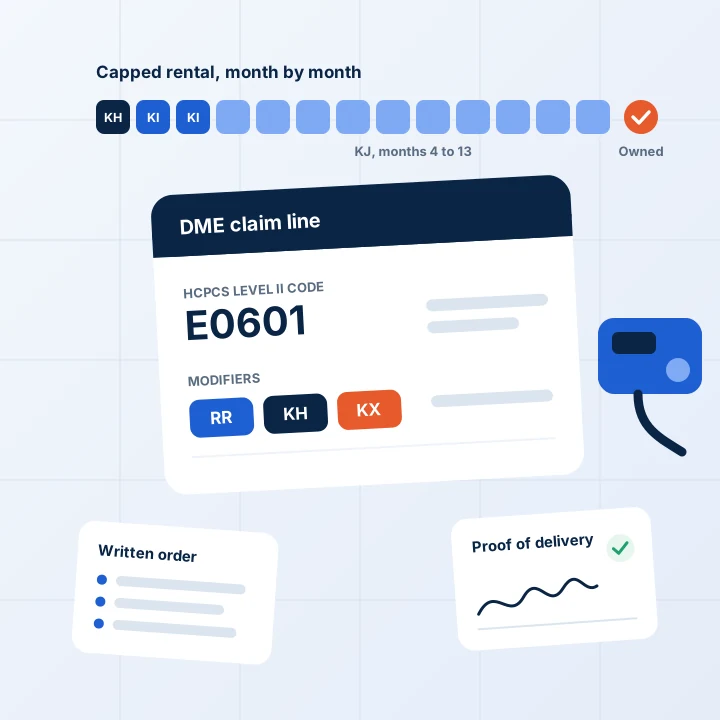
A patient leaves the practice with a walker, a CPAP or a hospital bed ordered for home. If the practice bills that equipment, the claim follows different rules from the visit it came out of. DME billing has its own code set, its own modifiers and its own paperwork. Medicare also sends most of these claims to a separate contractor. One wrong field is enough to stop the claim. This guide covers the codes, the modifiers that decide how Medicare pays, and the records Medicare checks. It answers one question: what has to be true about the code, the modifier and the paperwork before a DME claim gets paid?
How does DME billing work?
DME billing runs in five steps, from the order to the last rental month. Each step leaves a record the payer can ask to see.
- Order and records. The treating practitioner signs a written order and documents why the patient needs the item.
- Code and modifier. The item gets a HCPCS Level II code and a pricing modifier that says whether it was bought or rented.
- Delivery. The patient or a designee signs for the item, and the delivery record is kept.
- Claim. The claim goes to the patient's payer and, for Medicare, to the contractor that handles that item.
- Follow-up. Payments are posted, and rentals are billed again each month with the right month modifier.
Who pays depends on the patient's coverage, and each payer sets its own rules.
Medicare Part B pays for medically necessary equipment ordered for use at home. Which equipment Medicare covers, and how often, is a separate question from how the claim is built.
Medicaid sets DME rules state by state. Each state publishes its own DME billing manual, with its own fee list, rental limits and prior authorization rules. A habit built on Medicare claims can be wrong on a Medicaid claim.
Commercial plans follow their contracts. They use the same HCPCS codes but can set their own rental periods and authorization lists.
DME billing codes: HCPCS Level II, not CPT
DME is billed with HCPCS Level II codes, five characters long: a letter followed by four digits. They are a separate code set from the CPT codes a practice uses for visits and procedures.
The first letter tells you the family:
- E codes cover durable equipment, such as E0601 for a CPAP device.
- K codes are assigned for the DME MACs and include many wheelchair codes, such as K0001 for a standard wheelchair.
- A codes cover supplies, such as the masks and tubing used with equipment.
- L codes cover orthotics and prosthetics, such as braces.
CPT still has a place. The practitioner's own visit, fitting or training is a separate service billed with CPT; the equipment line is not.
The code names the item; how Medicare pays for it depends on the item's payment category, covered next. CMS revises the code set every year, with quarterly updates in between, so each code is checked against the current HCPCS file.
Purchase, rental or capped rental: the modifiers that set how Medicare pays
Medicare pays each DME item under a payment category, and the category sets the first modifier: NU or UE to buy, RR to rent. Capped rentals add a month modifier on every line. The category comes with the code, so the biller looks it up rather than chooses it.
| Payment category | How Medicare pays | First-position modifier | Example |
|---|---|---|---|
| Inexpensive or routinely purchased | Purchase or rental; total payments capped at the new purchase price | NU, UE or RR | Canes, walkers |
| Capped rental | Monthly rental for up to 13 continuous months: 10% of the purchase price in months 1 to 3, 7.5% in months 4 to 13; then the patient owns it | RR, plus KH, KI or KJ | CPAP device (E0601) |
| Frequent and substantial servicing | Monthly rental for as long as the patient needs the item; no 13-month cap | RR | Ventilators |
Inexpensive or routinely purchased items can be bought or rented, and the supplier must offer the patient that choice. Whichever way it goes, Medicare's total payment stops at the new purchase price.
Capped rental is where most billing errors repeat. Payment stops after 13 continuous months, and title passes to the patient the next day, under 42 CFR 414.229.
Each rental month is its own claim line. Month 1 carries RR and KH, months 2 and 3 carry RR and KI, and months 4 to 13 carry RR and KJ. The official KJ description reads months four to fifteen because it also covers parenteral and enteral nutrition pumps. Capped rental still ends at month 13.
Capped rental
Thirteen monthly claim lines, then the patient owns the item
Every line carries RR first, then the month modifier. Ten of the thirteen lines carry KJ.
Month modifier on each rental line
That monthly rhythm is why one gap costs more than one claim. A missing order element or a wrong delivery date can deny every month that rests on it, up to 13 times.
Frequent and substantial servicing items, such as ventilators, are rented month by month for as long as the patient needs them. They carry RR, and payment continues monthly with no 13-month cap.
KX goes after the pricing modifiers: on a capped rental line, that means RR, then the month modifier, then KX. On a DME claim, KX says the item's medical policy requirements are met and the records are on file, per Noridian JD DME. It is not the therapy KX used on physical therapy claims.
Northgate Billing bills DME and HME claims inside each practice's own billing software.
What Medicare needs on file before a DME claim goes out
Three records support every Medicare DME claim: a standard written order, medical records that meet the item's coverage policy, and proof of delivery. The claim can be filed without them, but it will not survive a review.
The standard written order: six elements
A standard written order has six required elements, set by 42 CFR 410.38:
- Beneficiary name or Medicare Beneficiary Identifier (MBI)
- General description of the item: a narrative, a HCPCS code, a code narrative, or a brand and model
- Quantity to be dispensed, if applicable
- Order date
- Treating practitioner name or NPI
- Treating practitioner signature
The order must be complete before the claim is filed. Items on the CMS required list also need the written order before delivery. They need a face-to-face visit within the 6 months before the order, too. Signature and date stamps are not accepted, with few exceptions.
Medical-necessity records and the LCD
The order says what was ordered; the medical record has to show why. Each item has a local coverage determination (LCD) and a policy article that list the coverage criteria. The treating practitioner's notes must meet them.
The rules that apply to every DMEPOS claim sit in policy article A55426. KX is only as good as the chart behind it.
Proof of delivery: the date on the claim
Proof of delivery is kept for 7 years from the date of service, and its date becomes the date on the claim. For direct delivery, the delivery slip shows:
- Beneficiary name
- Delivery address
- Item description: a narrative, a HCPCS code, a code narrative, or a brand and model
- Quantity delivered
- Date delivered
- Beneficiary or designee signature
The date the patient received the item is the date of service. Items sent by a shipping service need a tracking or invoice number. That number links the supplier's records to the carrier's (CMS delivery guide).
Where DME claims fail
Most DME denials trace back to one of the three records above, or to the wrong modifier. Common causes are an order missing an element or notes that miss the item's policy. Others are a mismatched delivery date, a missing month modifier or KX, and no prior authorization where one is required.
When an item may not meet its policy, an Advance Beneficiary Notice signed before delivery lets the supplier bill the patient if Medicare denies. Without one, the patient generally cannot be billed for a medical-necessity denial.
A denied DME claim follows the same steps as any denied claim. Read the reason code, correct the record, then resubmit or appeal.
How do I bill Medicare for DME?
For items billed to a DME MAC, a practice needs four things in place. They are DMEPOS supplier enrollment, the three records, the right code and modifiers, and the right contractor.
Enrollment comes first. For these items, Medicare pays only an enrolled DMEPOS supplier. That enrollment is separate from the practice's own. DME supplier enrollment includes accreditation and a surety bond.
Then the contractor. Most DMEPOS claims go to the DME MAC that covers the patient's state. Four DME MACs split the country by region, and the DME MAC jurisdictions page lists them.
Not every code goes there. The DMEPOS fee schedule file marks each code's jurisdiction. D means the DME MAC, L the local Part B contractor, and J joint. A code marked L or J is checked before the claim is built.
For the wider rules on assignment and what a provider can charge, see participating provider rules.
All of this assumes one thing: that the practice can bill Medicare as a DME supplier at all.
Conclusion: what DME billing asks of a practice
DME billing asks a practice to get three things right on every line: the HCPCS code, the modifier for the item's payment category, and the records behind both. Not every practice should take it on. A practice that dispenses a handful of items a year may refer patients to an enrolled supplier instead. For that practice, enrolling may cost more than it returns.
The pricing page shows how DME billing is priced. Practices that do bill equipment can see how medical billing services handle it and where DME and HME billing sits among the specialties. Northgate Billing signs a Business Associate Agreement under 45 CFR 164.504(e) before it handles any order or delivery record. The next question comes before the first claim: what does it take to become a Medicare DME supplier?
Frequently asked questions
What are DME codes in medical billing?
They are HCPCS Level II codes, the national code set CMS maintains for equipment, supplies and other items that CPT does not cover. Each code is one letter and four digits, and the letter groups the item, such as E for equipment or L for orthotics. On a DME claim, the code works together with a pricing modifier and the supporting records.
What are the CMS DME billing guidelines?
The core rules sit in 42 CFR 410.38 for orders and 42 CFR part 414 subpart D for payment. CMS adds detail in its claims processing and program integrity manuals. Each item also has an LCD and a policy article, and article A55426 sets documentation rules for every DMEPOS claim. In practice, the guidelines come down to the order, the medical records and proof of delivery.
Do DME codes require a modifier?
Most equipment codes do. A purchase or rental needs a pricing modifier, and a capped rental adds a modifier for the rental month. KX is added only when the item's coverage policy calls for it, and many supplies take no pricing modifier at all. A missing or misplaced modifier is enough on its own to stop a DME claim.
Is DME covered under Medicare?
Yes. Medicare Part B covers DME that is medically necessary, ordered by the treating practitioner for use at home, and expected to last at least 3 years. It must also come from a Medicare-enrolled supplier. Coverage is not the same as a paid claim, though: each billed item still needs records that meet its policy.
What are the Medicare DME fee schedule rates for 2026?
Medicare publishes 2026 rates in the DMEPOS fee schedule files on the CMS website, with one amount per HCPCS code and pricing modifier. Amounts vary by state and by whether the delivery ZIP code is rural, and CMS updates the files quarterly. For capped rental items the monthly amount also drops after month 3, so the rental month on each claim line matters.
What is a standard written order for DME?
It is the treating practitioner's signed order for the item, and Medicare sets six required elements for it. Together they show who the patient is, what was ordered, how many, when, and who ordered it. For most items the order must exist before the claim is filed; items on the CMS required list need it before delivery.
What percentage does Medicare usually pay towards DME?
Medicare usually pays 80% of the approved amount for covered DME, and the patient pays 20%. That split applies after the Part B deductible, which is $283 in 2026. When the supplier accepts assignment, the patient's share stays at 20% of the approved amount. For rented items the split applies to each monthly payment, so the patient's share repeats with every rental month billed.