
In this article8 sections
- 01Three jobs that become yours on your last day
- 02What the hospital’s payer contracts actually covered
- 03Credentialing for a physician leaving hospital employment for private practice
- 04The gap between your last paycheck and your first payment
- 05What the contract you are leaving still controls
- 06When to hand the revenue cycle to someone else
- 07Conclusion: the order the steps come in
- 08Frequently asked questions
Key takeaways
- Contracts do not travel. Payer agreements belong to the hospital’s tax ID and Type 2 NPI, not to the physician who used them
- 90 to 180 days. Typical commercial credentialing and enrollment time for a new practice, which is why it starts before the resignation letter
- Medicare is the exception. The effective date is the later of the filing date or the first date of service, with up to 30 days of retroactive billing
- Notice overlaps the gap. Most physician contracts require 60 to 120 days of notice, and that window is the one chance to run credentialing in parallel
- Three jobs become yours. Get in-network, get paid, get found. None of them was yours as an employee
- The first claim is a milestone, not a start. Enrollment, clearinghouse setup and EFT and ERA enrollment all come before it
Leaving hospital employment changes how a physician gets paid before it changes anything clinical. Most of what gets read about the move is contracts, covenants and autonomy. Those matter. They are also not the thing that decides whether the practice has money coming in by month four.
The hospital ran a revenue cycle around every patient encounter. It held the payer contracts, it billed under its own numbers, and it employed the people who chased the denials. None of that leaves with the physician. This post covers what changes about getting paid when a physician leaves hospital employment for private practice, and how long the change takes.
Three jobs that become yours on your last day
A hospital-employed physician takes on three jobs on the day they leave: getting in-network, getting paid, and getting found. The hospital did all three invisibly, and each one now has a named owner inside the new practice.
Getting in-network
Getting in-network means insurance credentialing services and payer enrollment under a new practice entity. Credentialing verifies the physician. Enrollment attaches that physician to a contract that lets a payer reimburse the new practice. Both have to be redone, and the next section explains why.
Getting paid
Getting paid is the daily work the hospital’s billing department used to absorb: coding, filing, posting payments, and working denials inside each payer’s appeal window. A practice can hire for it, buy software for it, or hand it to a medical billing services partner, but it cannot skip it.
Getting found
Getting found is patients and referrals, which do not follow automatically. Hospital systems route them. A new practice has to tell its own patients it exists, inside the rules for notifying patients when you leave.
What the hospital’s payer contracts actually covered
The hospital’s in-network status sat with its tax ID and its Type 2 NPI, the number that identifies an organization rather than a person. A departing physician carries an individual NPI and a credentialing history, but no contract.
A payer sees a new practice as a new applicant. The physician may have been in-network with that same payer for a decade. The contract was between the payer and the hospital, so a new entity with a new tax ID starts a new application.
Two NPIs do two different things. A Type 1 NPI belongs to the individual and does not change when employment ends. A Type 2 NPI belongs to the practice, and a new practice needs its own.
Some things do carry over. A state medical license, DEA registration, board certification and an existing CAQH profile all stay with the physician. They shorten the paperwork. They do not shorten the payer’s review.
The first filings after you leave run in a fixed order: what to file, and in which week.
Credentialing for a physician leaving hospital employment for private practice
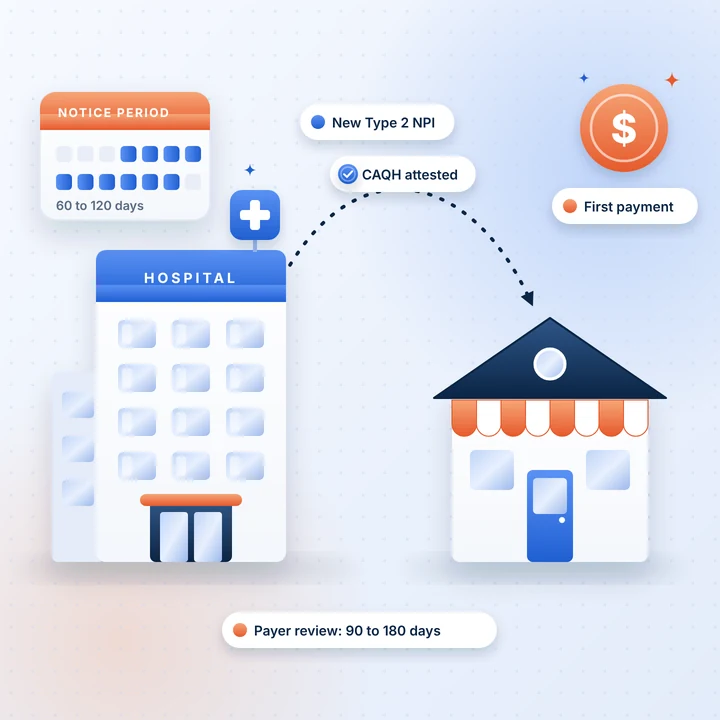
Credentialing after leaving a hospital runs in four steps under the new practice entity. Most commercial payers take 90 to 180 days from a clean application. The steps have an order, and the order is what decides the timeline.
Set up the entity and its numbers
Nothing can be filed until the practice exists on paper. That means a legal entity, an EIN from the IRS, and a Type 2 NPI for the entity. State law has to permit the entity type chosen. Every later application asks for all three.
Update CAQH and attest
A CAQH Provider Data Portal profile, still widely called CAQH ProView, already exists for most physicians, and payers pull from it during review. It has to point at the new practice address, the new tax ID and current malpractice coverage, and then be attested. A stale profile is one of the most common reasons an application sits.
File with Medicare through PECOS
Medicare enrollment is filed through PECOS. Under 42 CFR 424.520(d), the effective date of billing privileges is the later of two dates. The first is the date a subsequently approved application was filed. The second is the date the physician first began furnishing services at the new practice. Up to 30 days of retroactive billing is allowed before that date, under 42 CFR 424.521(a). Filing early does not buy an earlier effective date. It buys an approval in hand on opening day.
Apply to commercial payers in order
Commercial applications do not go out all at once. Payer mix decides which ones matter, and a practice that applies everywhere splits its own follow-up across applications it does not need. Work out which insurance companies to credential with first.
Credentialing through northgatebilling.com enrolls a physician’s new practice entity with Medicare and commercial payers under its own Type 2 NPI. One flat fee per provider covers the first eight payers, and additional payers are priced per payer.
| Step | Typical time | Who owns it | When to start it |
|---|---|---|---|
| Entity, EIN and Type 2 NPI | 1 to 2 weeks | Physician, with an attorney and CPA | First, before any payer filing |
| CAQH update and attestation | 1 to 2 weeks | Physician | The same week the Type 2 NPI issues |
| Medicare enrollment via PECOS | 60 to 90 days | Credentialing service or practice manager | Day one of the notice period |
| Commercial payer applications | 90 to 180 days | Credentialing service or practice manager | Day one of the notice period, in payer order |
| First paid claim | 2 to 6 weeks after a payer loads the contract | Billing service or in-house biller | Not a date you choose |
Timeline
Credentialing runs inside the notice period
Start every filing on day one of notice, and the two waits overlap.
Start filings on day one of the notice periodWait until the last day, and the two windows run end to end
The gap between your last paycheck and your first payment
Commercial credentialing runs 90 to 180 days from a clean application, and that window decides when the first in-network payment lands. The notice period is the only part of it a physician controls, and it is usually 60 to 120 days long.
Run credentialing during notice and the two windows overlap. Wait until the last day and they run end to end, which is how a 90-day gap becomes a six-month one.
Worked example, illustrative
A hospital-employed internist with a 90-day notice clause.
- January 6: Notice served. Last day of employment is April 6.
- January 8: Entity formed, EIN issued.
- January 13: Type 2 NPI issued.
- January 20: CAQH profile updated and attested.
- January 22: PECOS application filed. Commercial applications go out the same week.
- March 30: Medicare approval returns. The effective date is April 7, the first date of service, not the January filing date.
- April 7: Practice opens. Medicare claims are billable from day one.
- April 7 onward: All seven commercial payers are still in review. Those patients are out-of-network until the contracts load.
- May 19: First commercial payment posts. That is 133 days after notice was served, and 43 days after the last day of employment.
Seeing patients while enrollment is pending is a decision, not a default. A practice can schedule those patients out-of-network, hold the claims until the contract loads, or reschedule them. Each option has a different cash effect and a different disclosure obligation to the patient.
Holding claims has a limit. Every payer sets a timely filing window, and a held claim that outruns it is written off. Anything held needs a date it will be released.
Every date in that example after January 22 follows from the ones before it. Run the same week by week sequence and the gap stays at weeks rather than months.
What the contract you are leaving still controls
Four clauses decide how fast a departing physician can start earning: notice, restrictive covenants, tail coverage and repayment obligations. Each one sets a date or a cost that the credentialing timeline has to work around.
Notice. Most physician contracts require 60 to 120 days. That window is the credentialing window, so the filing date matters more than the resignation date.
Restrictive covenants. Non-compete radius, duration and patient-solicitation terms decide where the practice can open and who it can contact. Enforcement varies by state, and several states have narrowed it. Read the clause against current state law, not against what a colleague was told.
Tail coverage. A claims-made malpractice policy needs tail coverage for claims filed after the physician leaves. AAFP puts the cost at 1.5 to 2 times the annual premium, and current quotes often run higher. The contract says who pays. That number belongs in the startup budget beside rent.
Repayment obligations. Unamortized sign-on bonuses, relocation stipends and loan assistance often come due on departure. The unamortized balance is a cash item in the same months as the revenue gap.
This is a summary, not legal advice. A healthcare attorney should read the actual agreement before notice is served.
When to hand the revenue cycle to someone else
Doing credentialing and billing in-house works for some new practices and not others. The line is usually drawn by how many payers are in play and who has time to chase them.
When to hand it off
Hand it off when the follow-up is the bottleneck, not the paperwork. The signals:
- More than four commercial payers in review at once
- No one whose job includes calling payers weekly
- A specialty where a single denial type repeats across most claims
- An opening date that has already moved once because of enrollment
What to keep either way
Keep the things that are yours even if the work is outsourced. A practice that hands over its logins keeps nothing when the relationship ends.
- The CAQH username and password, held by the practice
- The PECOS account and its security credentials
- A dated file of every payer application, confirmation number and reply
- The effective date for each contract, written down
There is an honest case against outsourcing. A solo practice with two payers and a patient panel that follows from the hospital may never need it. The first-year fee buys little that a careful practice manager cannot do.
What any service should give you
Ask for these four things before signing with anyone:
- A named person who owns your applications
- Written status on every payer, updated on a set day
- The effective date for each contract as soon as it loads
- Your own copies of everything filed on your behalf
Credentialing ends the day the contracts load. The work that starts then, coding, filing, denials and follow-up, is what a medical billing company does week in and week out.
Northgate Billing files practice enrollments through PECOS and CAQH and works under a business associate agreement as required by 45 CFR 164.504(e).
Whoever does the work, the practice stays the applicant of record with every payer.
Conclusion: the order the steps come in
The steps come in a fixed order, and doing them out of order is what adds months. The entity has to exist before the NPI. The NPI has to exist before CAQH can point at it. CAQH has to be attested before a payer will review anything.
Most of the delay in a new practice is not payer review time. It is the weeks lost filing step three before step one was finished. The order is the part a physician controls completely. The sequence from EIN to first claim is worth having in writing before the notice letter goes out.
Frequently asked questions
Is it better to work in a hospital or private practice?
Neither is better in general, and the honest version of the question is how much revenue risk a physician wants to carry. Hospital employment pays a predictable salary and absorbs the billing. Private practice pays what is left after overhead, and only once the new entity is enrolled with its payers. That enrollment, not the clinical work, decides when the income starts.
Why are physicians leaving private practice?
Three pressures drove the shift toward employment: declining reimbursement, rising overhead and malpractice premiums, and the administrative load of prior authorizations. Independent practices absorbed those costs without a system’s negotiating power. Physicians moving the other way, back into ownership, face the enrollment timeline described above, because the contracts they once billed under belonged to the employer.
What are the happiest physicians?
There is no single happiest specialty. The answer usually comes down to control: over schedule, over volume, and over which payers the practice works with. Predictable hours and a say in how the work is organized matter more than the specialty itself. In a new practice, that control arrives only once the entity is in-network and paid.
Does my credentialing transfer when I leave a hospital?
No. Credentialing verifies the physician, but the in-network contract sits with the employer’s tax ID and Type 2 NPI. A new practice is a new applicant, even with the same payer and the same physician. The verified history shortens the paperwork and does not shorten the payer’s review, which typically runs 90 to 180 days.
When should I start credentialing if I am leaving hospital employment?
On the first day of the notice period, once the entity and its Type 2 NPI exist. Notice periods of 60 to 120 days run in parallel with payer review, so starting then collapses two waits into one. Starting after the last day of employment adds the whole notice period to the revenue gap.
Do I keep my NPI when I leave hospital employment?
Yes for the individual number, no for the organization’s. A Type 1 NPI belongs to the physician and does not change with employment. The Type 2 NPI used on hospital claims belongs to the employer. A new practice applies for its own Type 2 NPI, and every payer application references it.
Can I see patients before credentialing is complete?
Sometimes, and the rules differ by payer. Some allow retroactive billing back to an effective date, some do not, and Medicare sets its own. The decision affects cash, patient disclosure and timely filing limits, so settle it with each payer before the opening date.
The order is the only part you control
Four filings, one order, mapped to the notice period.
Read the setup guideOr see what credentialing covers.

Written by
Zephran Melwick
Credentialing Specialist, Northgate Billing
This article is general information about payer enrollment and practice setup. It is not legal advice, and contract terms vary by employer and by state.