
In this article8 sections
- 01What are the CMS requirements for billing under incident-to?
- 02Who has to supervise, and whose NPI goes on the claim
- 03What is an example of an incident to billing?
- 04Where incident-to stops applying
- 05When to hand incident-to billing to a billing team
- 06Conclusion: incident-to billing for your NPs and PAs
- 07Frequently asked questions
- 08Starting a practice with NPs or PAs on the schedule?
Key takeaways
- Every condition, every visit: Medicare pays an incident-to claim only when every condition in 42 CFR 410.26 and the Benefit Policy Manual holds on that date of service.
- Physician first: the physician performs the initial service and sets the plan; the NP or PA handles follow-up care under it.
- Virtual supervision is permanent: since January 1, 2026, direct supervision can be met by real-time audio and video.
- Behavioral health is looser: behavioral health services furnished incident-to need only general supervision, under a rule CMS finalized for 2023.
- The supervisor bills: only the physician who supervised the visit may bill it, even when another physician wrote the plan.
- Commercial rules differ: some Blue plans, including Blue Cross NC since December 1, 2025, require credentialing-eligible NPs and PAs to bill under their own NPI.
- Under review: the HHS Office of Inspector General opened an audit of Part B incident-to payments in November 2024.
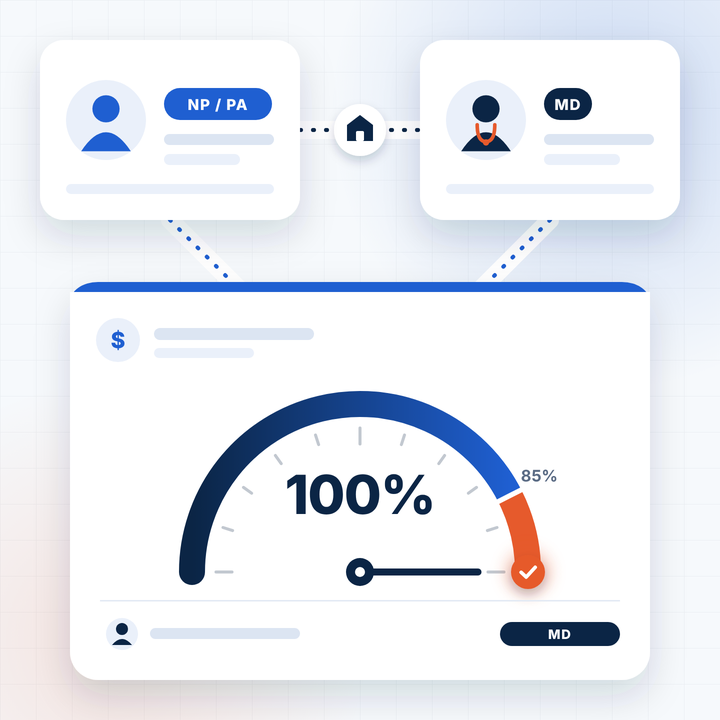
Incident to billing lets a practice bill an NP's or PA's follow-up visit under the supervising physician's NPI, at the full physician rate. Each visit has to qualify on its own. If your NPs or PAs see established patients, the question is practical: which of their visits can go out under the physician?
What are the CMS requirements for billing under incident-to?
Medicare pays a service incident to a physician only when every condition in 42 CFR 410.26 and the Medicare Benefit Policy Manual holds. The setting is not a hospital or skilled nursing facility, and the physician started the care. The service is part of that care, a physician supervises, and state law allows it.
- Noninstitutional setting. The service happens in an office, clinic or other setting that is not a hospital or skilled nursing facility.
- Physician starts the care. The physician performs the initial service, sets the plan and stays actively involved in the course of treatment.
- Integral to that care. The service is part of the physician's diagnosis or treatment of that illness or injury.
- Employment or contract. The NP or PA is an employee, leased employee or independent contractor of the physician or the same entity.
- Included in the physician's bill. The service is commonly furnished without a separate charge or is included in the physician's bill.
- Supervision. A physician directly supervises the service, with 2 exceptions covered below.
- State law. The NP or PA works within state scope of practice and is not excluded from federal health programs.
The employment rule is wider than many guides say. The regulation counts leased employees and independent contractors who receive an IRS 1099, not only W-2 staff.
Decision check
Does this visit bill at 100% under the physician?
Every answer has to be yes, on that date of service. Behavioral health services need only general supervision.
- 1Did the physician see the patient first and set the plan?No: bill under the NP’s or PA’s own NPI
- 2Does this visit follow that plan, with no new problem?No: bill under the NP’s or PA’s own NPI
- 3Is a physician supervising directly, in the suite or on live video?No: bill under the NP’s or PA’s own NPI
- 4Is it an office setting, not a hospital unit?No: incident-to does not apply
Who has to supervise, and whose NPI goes on the claim
Direct supervision means a physician is immediately available, in the office suite or, since January 1, 2026, by real-time audio and video. The CY 2026 Physician Fee Schedule final rule made virtual direct supervision permanent for incident-to services. Audio-only does not count. Services with a 010 or 090 global surgery indicator still need the physician on site.
The supervising physician does not have to be the one who wrote the plan. Any physician in the group who supervises that visit can fill the role. But only the supervising physician may bill the service, so the claim goes out under that physician's NPI.
General supervision, where the physician directs the care but need not be present, is enough for 2 groups of services. Care management services such as chronic care management are one. Behavioral health services are the other, under a change in the CY 2023 final rule. That matters for mental health practices that use counselors or therapists as auxiliary staff.
Northgate Billing bills from inside the practice's own software, using the codes and supervising physician the practice records. It checks each claim for errors before the payer sees it.
What is an example of an incident to billing?
A typical incident-to visit is an NP's follow-up on a problem the physician already diagnosed and planned, with a physician supervising. For example, a physician diagnoses high blood pressure and starts a medication. The NP rechecks the reading 6 weeks later and adjusts the dose within that plan while the physician sees patients down the hall.
That visit goes out under the supervising physician's NPI and pays at the physician rate. The table shows how small changes to the same visit move the claim.
| Scenario (illustrative) | Bills under | Why |
|---|---|---|
| NP rechecks blood pressure under the physician's plan; physician in the suite | Supervising physician | Every condition met |
| Same visit; supervising physician on a live video link, not on site | Supervising physician | Virtual direct supervision allowed from January 1, 2026 |
| Same visit; physician reachable only by phone | NP's own NPI | Audio-only is not direct supervision |
| Same visit; a different physician in the group supervises | The physician who supervised | Only the supervising physician may bill |
| Patient raises new knee pain and the NP treats it | NP's own NPI | No physician plan for the new problem |
| New patient's first visit is with the PA | PA's own NPI | The physician must perform the initial service |
| NP sees the patient on a hospital inpatient unit | Not incident-to | Hospitals are institutional settings |
Where incident-to stops applying
Incident-to stops applying at 4 common points. They are a new patient, a new problem, a hospital or skilled nursing facility, and a payer that does not recognize it. At each one, the visit bills another way.
New patients and new problems
A new patient, or a new problem the NP or PA treats, bills under the NP's or PA's own NPI. That route pays a lower Medicare rate, and billing for NPs and PAs under their own NPI compares the two.
Billing in their own name also requires the NP or PA to be enrolled with each payer. Whether an NP can see patients before that is approved is answered in credentialing a nurse practitioner. Practices that want the enrollment handled can review insurance credentialing services.
Hospitals and skilled nursing facilities
Incident-to does not apply in a hospital or skilled nursing facility, because both are institutional settings. When a physician and an NP work together there, the visit follows the split or shared visit rules instead.
Payers that don't recognize incident-to
Some commercial plans and Medicaid programs do not recognize incident-to, so the NP or PA bills under their own NPI. Each payer's written policy decides, as the FAQ below explains.
When to hand incident-to billing to a billing team
Incident-to billing is worth handing off once the supervision and plan checks cannot keep pace with the schedule. That point usually arrives when one of these is true:
- More than one physician supervises, so the NPI on the claim changes with who was on site or on video that day.
- NPs or PAs often address new problems in visits that started as follow-ups.
- Commercial payers in your mix publish their own incident-to policies, and some changed in 2025 or 2026.
- Incident-to claims have already been denied, downcoded or recouped.
The counter-case is a solo physician working with 1 NP in the same office. When the schedule makes supervision obvious and every payer follows Medicare, a clear note template may be all the practice needs. A billing service will not fix visits that never met the conditions.
Northgate Billing signs a Business Associate Agreement under 45 CFR 164.504(e) before it accesses any patient record or submits an incident-to claim. Scope and process are on the medical billing services page.
Published pricing is 7% of collections on the first $25,000 a month, stepping down to 3% above $500,000. The minimum is $450 per provider per month.
Conclusion: incident-to billing for your NPs and PAs
Incident-to pays the physician rate only when the plan, the supervision and the setting line up on the date of service. The 2026 change to virtual supervision widens who can supervise, but not who may bill. For a practice building this from day one, the next question is how billing gets set up before there is any claims history.
Frequently asked questions
Is an incident to billing legal?
Yes. Incident-to is a Medicare Part B benefit set out in 42 CFR 410.26, so billing it is legal when every condition is met. Billing visits that miss a condition creates overpayments that must be repaid and can lead to fraud liability. The OIG has an open audit of incident-to payments, so the real test is whether each visit's note proves the conditions.
What are the CMS incident-to-billing guidelines for 2026?
The core conditions did not change for 2026. What changed is where the supervising physician can be. Since 2020, live video supervision had been allowed only as a temporary pandemic-era flexibility, extended year by year through December 31, 2025. From January 1, 2026, it is permanent for most incident-to services.
What documentation is required for incident to billing?
The note should show who performed the service and which physician supervised. It should show that physician was in the suite or on a live video link. It should tie the visit to the plan set at the initial service and show the physician's ongoing involvement. Medicare's incident-to rules list no cosignature requirement, though many practices add one.
Does BCBS allow incident-to billing?
It depends on the plan, because each Blue Cross Blue Shield company sets its own policy. Blue Cross NC, for example, stopped paying incident-to for credentialing-eligible NPs and PAs on December 1, 2025; they must bill under their own NPI. Check the plan's reimbursement policy before billing an NP or PA visit under the physician.
Is incident-to billing only for Medicare?
No, but Medicare defines it. Medicare Part B sets the rules this article covers, and commercial plans and state Medicaid programs decide for themselves whether to follow them. Some adopt Medicare's conditions, some add their own, and some do not recognize incident-to at all. For any non-Medicare visit, the payer's written policy decides whether it can bill under the physician.
Which scenario qualifies for incident-to billing?
A visit qualifies when it involves an established patient and an existing problem with a physician-set plan. The setting is not a hospital or skilled nursing facility, and a physician supervises on site or by live video. The NP or PA must also be employed or contracted by the practice. Change any one and the visit bills under the NP's or PA's own NPI, as the table above shows.
Does the physician have to see the patient every third visit?
No. Medicare sets no fixed visit count. The Medicare Benefit Policy Manual asks for physician visits at a frequency that reflects active participation in the patient's care, and that varies by condition. A patient with heart failure needs the physician more often than one with a stable chronic problem. The record should show that involvement, whatever the schedule.
Starting a practice with NPs or PAs on the schedule?
See how billing gets set up before there is any claims history.
Read the new practice setup guide Or see medical billing services
This article explains Medicare and payer billing rules in general terms. It is not legal advice. Rules change, so check the current regulation and each payer's written policy before billing.