Where new patients actually come from now
Most new patients now arrive through a search, whatever started it. In rater8's 2026 survey of 992 US patients, 72% had chosen or looked for a new doctor in the past year. Of those searchers, 55% started by typing some version of a specialty near them.
What happens next is the part most practices never see. The patient reads a listing, checks the star rating, reads a few reviews, and only then opens a website. Friends and family remain the largest single influence, named by 43% of searchers, alongside insurance websites at 43% and review sites at 40%.
That is a different order of events from the one a referral-built practice is used to. Word of mouth used to deliver a patient's name and a phone number. Now it delivers a name that the patient types into a search box, where a dozen other practices are waiting.
Marketing for medical practices is really the work of making sure that search ends with your phone ringing. There is more on how patients choose a doctor online in its own article. The question this one answers is narrower: of everything you could do, what comes first?
How can I attract more patients to my practice?
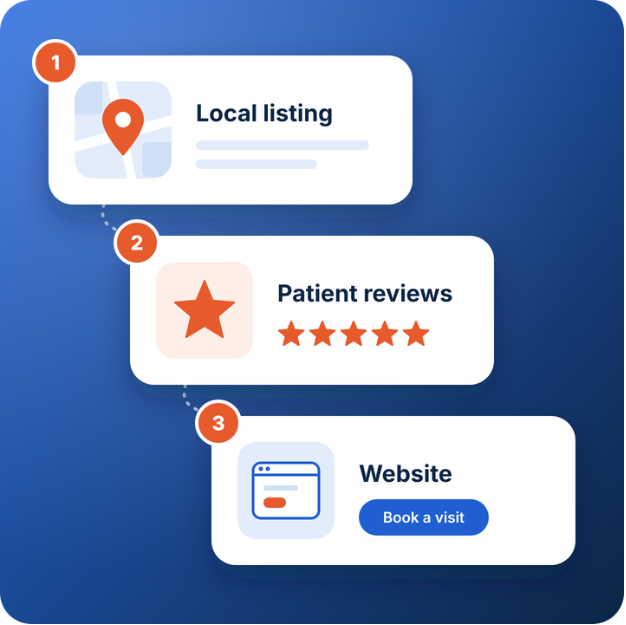
Build three things, in this order: local listings, a steady flow of recent patient reviews, and a website that takes a booking. Everything else, social media, ads, referral lunches, supports those three. None of it replaces them.
The order is not a preference. It is the sequence the patient moves through.
A listing is what gets you into the result at all. If the practice does not appear when someone searches for a specialty near them, nothing downstream matters, because the patient never sees it. Reviews get you past the filter. 75% of patients will not book below 4.0 stars. A practice rated 3.8 is removed from the list before anyone reads a word about it. The website is where the decision becomes an appointment. In BrightLocal's 2026 survey of 1,002 US consumers, 54% visit a business's website after reading positive reviews, up from 32% in 2019.
Build them in the other order and you waste the work. A beautiful website that nobody finds is an expensive brochure. Reviews on a listing that does not appear in search are reviews nobody reads.
The patient path
Four stops between a search and a booked visit
Each of the three channels does its work at one or two of these stops.
- 1 · Search 55% of patients looking for a doctor start with a specialty near them Listings
- 2 · AI answer 89% of healthcare searches on Google show an AI Overview Listings
- 3 · Reviews 75% of patients will not book below a 4.0-star rating Reviews
- 4 · Website 54% of people visit the website after reading positive reviews Website
Easy win68% of patients would leave a review if their doctor asked. 42% rarely or never leave one on their own.
Channel one: local search and listings
A complete set of listings is the cheapest new-patient channel a practice has. It is what answers the specialty-near-me search, and it costs an afternoon to set up plus a monthly check.
It also now feeds something bigger. 89% of Google searches with a healthcare keyword trigger an AI Overview, according to BrightEdge research through 2025, cited in rater8's 2026 report. Asked which part of a Google results page they trust most, 37% of patients chose the AI Overview. Organic blue links took 20% and the map pack 13%. The AI answer is not a separate channel. It is assembled from your listings, your reviews and your site, which means the listing work pays twice.
What a map result is built from
Six things: the practice name, the primary category, the address, the hours, the services listed, and the reviews attached to the profile. A patient sees all six before they see your website.
The category is the one most practices get wrong. It decides which searches you are eligible to appear in at all. There is more detail on how these results are ranked in the Google map pack for medical practices.
What to fill in first
Fill in the fields that decide whether you appear, before the ones that decide how you look.
- Primary category, then secondary categories for each service line
- Address and hours, matched exactly to your website and your insurance directory entries
- Phone number, the one a person answers
- Services and insurances accepted
- Photos, last
Consistency matters more than polish. Among patients who used AI to research a provider, 66% had been given incorrect information: wrong addresses, phone numbers, hours or insurance details. AI tools repeat what your listings say. If three directories disagree, so will the answer a patient gets.
How long before it shows
Verification comes first, and until it is done the profile does not appear. Google's documentation says the verification review can take up to 5 business days. After that, changes to an existing profile usually appear within days, not weeks. The full setup, verification and upkeep routine is covered in Google Business Profile for doctors.
Channel two: the reviews patients read before they call
Reviews decide whether a patient who has found you will call you. 55% of patients have canceled an appointment or avoided booking because of what they read. That is up from 40% in rater8's 2025 survey, nine months earlier.
The effect is a cutoff rather than a slope. 75% of patients will not book below 4.0 stars, and 44% will not book below 4.5. A practice at 3.8 is not losing a close comparison. It is being removed from the list before anything else about it is considered.
What patients complain about is worth knowing, because it is rarely clinical. Rude or unhelpful staff and the doctor did not listen both sit at 52%. Substandard care follows at 45%, long waits at 41% and billing problems at 40%. Three of those five describe the front office rather than the medicine.
How many reviews, and how recent
Enough to clear a floor, and new enough to look current. In BrightLocal's 2026 survey of US consumers, 47% would not use a business with fewer than 20 reviews. 74% only counted reviews written in the last three months.
That makes review collection a routine, not a project. Twenty reviews gathered once and left alone will read as stale within a year. A handful every month keeps the profile current and the rating moving.
Responding matters as much as collecting. 66% of patients say a provider's response to reviews affects whether they trust that provider. That was the largest single change in rater8's survey year over year.
How to ask without breaking the rules
Ask every patient, the same way, and never pay for the answer.
Asking works. 68% of patients say they would leave a review if their doctor asked, while 42% rarely or never leave one unprompted. The gap between those two numbers is the whole opportunity.
Two rules bound how you ask. Under the Federal Trade Commission's rule on consumer reviews and testimonials, buying reviews or offering anything in exchange for a positive one is prohibited. Under HIPAA, a public reply may not confirm that the reviewer is a patient or mention their care, even when the review does. Thank them, state your general policy, and move the specifics to a phone call.
The mechanics of asking, and what to say, are set out in how to get patient reviews.
Channel three: a website that takes the booking
The website's job is to turn an interested patient into a booked appointment. 54% of people visit a business's website after reading good reviews. By that point they have already decided you are worth considering. The site either closes the gap or loses them.
Three things do most of that work.
A page for each service you want patients for.
One page listing eleven services ranks for none of them. A page per service, written in the words patients use rather than the words charts use, gives the search something to match. It also gives the patient something to recognize.
Contact details a phone can act on.
A tappable number, the address and the hours, on every page, not only on a contact page. Most of this traffic is on a phone, mid-search, with two other practices open in other tabs.
A way to book that does not require a phone call.
Not every patient can call during office hours, and some will not call a practice they have not met. A request form that someone checks twice a day is enough. It does not have to be a portal.
One more thing the site has to do: agree with your listings. Insurance directories and third-party listings are already inconsistent, and AI tools repeat whatever they find. Your own site is the one source you fully control.
The three channels compared
Each channel does one job, and none of them does another channel's job.
| Channel | What it does | What you supply | What it cannot do |
|---|---|---|---|
| Local search and listings | Puts the practice in front of the 55% who search for a specialty near them, and feeds the AI answers 89% of health searches now show | An afternoon to set up, a monthly check for accuracy | Convince anyone. A listing gets you seen, not chosen |
| Patient reviews | Clears the 4.0-star threshold that 75% of patients apply before they read anything else | A routine for asking after every visit, and a reply to every review | Fix the reasons behind bad reviews. Three of the five top complaints describe the front office, not the medicine |
| Your website | Turns the 54% who arrive after reading reviews into appointments | A page per service, contact details, and one way to book without calling | Bring anyone on its own. Nobody searches for your website |
Sources: rater8, 2026 Patient Choice Report, 992 US patients; BrightLocal, Local Consumer Review Survey 2026, 1,002 US consumers; BrightEdge, AI Overviews in healthcare search, 2023 to 2025.
Where social media, ads, SEO and referrals actually fit
These support the first three. They rarely start a patient's search, and they work far better once listings, reviews and the website are in place.
Social media is for the patients you already have.
It ranked seventh of the eight sources rater8 measured for choosing a new doctor, behind review sites, Google search and doctor referrals. Almost nobody opens Instagram to find a cardiologist. What social does well is keep a practice familiar to people who have already been in. It also gives an existing patient something to send to a friend. Judge it on that, not on new appointments.
Paid search buys position, not trust.
Ads put you at the top of a page tomorrow, which helps a brand new practice or a new service line with no rankings yet. But only 7% of patients named sponsored results as the most trustworthy part of a Google page, against 37% for the AI Overview. An ad that sends a patient to a listing with no reviews is paying to be rejected faster. How much should a medical practice spend on marketing? That question has its own article: medical practice marketing cost.
Referrals are still the largest single influence, and the slowest to build.
Friends and family were named by 43% of searchers, tied with the insurance website. The insurance directory entry deserves a mention of its own. For many patients it is the first filter, and it is also one of the listings most likely to be out of date.
None of this is wasted effort. It is effort that pays after the first three are done, not before. There is more on how to get more patients once that foundation exists.
When it is time to hand the marketing off
All three channels can be run in-house. The real question is whether they will still be done in six months, because the part that works is the part that repeats.
When to hand it off
Hand it off when the routine has already stopped. The usual signs:
- The last review on the profile is more than two months old
- Nobody has looked at the listing since it was set up, and the hours are wrong
- Negative reviews sit without a reply
- The person who was doing it has left, or has been absorbed into front-desk cover
If none of those apply, keep doing it yourself. A practice with a current profile, a monthly review routine and a working site does not need help, and paying for one would buy nothing.
What to keep either way
Ownership, whoever does the work.
- The Google Business Profile stays in an account the practice owns, with a practice email as the primary owner
- The domain name is registered to the practice
- The website files and content can be exported
- Review requests go out from the practice's own name
If a vendor holds any of these, leaving them means starting over. Ask before you sign, not after.
What any service should give you
- A named person who answers, not a ticket queue
- A monthly report of calls and new patients, not impressions and followers
- Review requests sent after visits, with no incentive attached, which the Federal Trade Commission rule prohibits
- Replies to reviews that do not confirm anyone is a patient, which HIPAA requires
Northgate Billing's practice marketing service runs these three channels for a practice. That covers the website on the practice's own domain, Google Business Profile upkeep, and review requests sent after visits. Northgate Billing sends those requests with no incentive attached, as the FTC rule on consumer reviews requires. Replies are written so that no patient relationship or treatment detail is disclosed, under HIPAA. How that work is scoped, and what each plan includes, is set out under medical practice marketing services.
Conclusion: what marketing for medical practices takes in the first month
Spend the first month on the listing, not the website. Claim and verify the profile, fix the category, and match the hours and address everywhere they appear. Then start asking every patient for a review on the way out. That is the whole first month, and it costs nothing but attention.
The website can wait until patients are finding you, because a site nobody reaches cannot fail or succeed. By then you will know which services patients are searching for, which is better information than any guess made in month one.
Most of the first month is spent inside one profile, and keeping that profile current is a monthly job rather than a one-time setup. What belongs in it, and what the upkeep actually involves, is the next thing to work out.
Frequently asked questions
What is the best way to advertise my medical practice?
The cheapest effective advertising is the kind you do not pay for: a complete local listing and a current set of reviews. Paid search works, and it puts you at the top of the page tomorrow. But sponsored results are the section fewest patients name as trustworthy. Advertising fills gaps once the three channels here are running.
What are the key trends in healthcare marketing for 2026?
Two matter for a small practice. Nearly half of patients have now used an AI tool to research a provider. Most health searches on Google return an AI summary built from listings and reviews. The second is recency: three quarters of people only count reviews written in the last three months. Both reward upkeep over campaigns.
How long does it take for marketing to bring in new patients?
Listings can produce calls within weeks of verification, because they decide whether you appear at all. Reviews move more slowly, since a rating only shifts as new ones arrive. A website changes nothing until the first two send people to it. The order matters more than the speed of any single channel.
What if my practice has almost no reviews yet?
Start asking, and give it a few months. Nearly half of consumers avoid a business with fewer than 20 reviews, so the first twenty matter most. Ask every patient the same way on the way out, in person or by text. A steady handful each month also keeps the profile current, which counts for as much as the total does.
Can I ask patients for reviews without breaking HIPAA?
Yes. HIPAA limits what you disclose, not what you request. In a public reply, do not confirm that the person is a patient or mention their care, even when their review does. Separately, the Federal Trade Commission prohibits offering anything in exchange for a positive review. Ask everyone the same way, after every visit.
Do I need a marketing agency to market my practice?
Not to start. Claiming a listing, correcting the hours and asking for reviews need no agency. Consider help when the routine has already lapsed: stale reviews, wrong hours, replies that never get written. The test is whether the work will still be happening in six months, which is when these channels either compound or stall.
Do I still need a website if I have a Google Business Profile?
Yes, for a different job. The profile decides whether patients find you and whether you clear their rating threshold. The website is where an interested patient books, and 54% of people visit a business's site after reading good reviews. A profile with nothing behind it sends interested patients nowhere, though the profile still comes first.