
In this article8 sections
- 01How the 8 minute rule works: one total, not one count per code
- 02The 8-minute rule chart: minutes to units
- 03Which minutes count toward the total
- 04Combining codes: how leftover minutes are split
- 05When a PT and an assistant share the minutes: CQ and CO
- 06Medicare’s 8-minute rule vs the CPT midpoint rule
- 07Conclusion: counting therapy units the Medicare way
- 08Frequently asked questions
Key takeaways
- Total first: Medicare adds all timed minutes in a day, then reads units off the chart. One extra minute can add a unit, as at 23, 38 or 53 minutes.
- Full blocks before leftovers: each full 15 minutes bills to its own code, then leftovers are compared. With 33 minutes of 97110 and 7 of 97140, the claim bills 2 and 1.
- 15-minute floor: any code done for 15 minutes or more gets at least 1 unit.
- Total-minute cap: units never exceed what the total allows. Four codes in 49 minutes still bill 3 units.
- Only direct treatment time counts: time the patient spends resting, waiting or being set up does not count.
- Assistant minutes: a unit billed with CQ or CO pays 15% less than the same unit furnished by the therapist. A therapist’s own 8 minutes can carry the final unit without it.
A therapy session rarely runs on one code. A patient gets therapeutic exercise, then manual therapy, then a few minutes of gait training. The claim needs a unit count that holds up on review. The 8 minute rule sets how many of those minutes become billable units.
The chart looks simple. The hard part is the split: which code gets the last unit when the minutes don’t divide evenly. This guide covers the chart, the minutes that count and how CMS itself splits the units. It answers two questions for any session: how many units it supports, and which codes get them.
How the 8 minute rule works: one total, not one count per code
Medicare adds every timed minute delivered in a day, across all timed codes, and the total sets how many units the claim can carry. A code on its own needs 8 minutes before it bills a unit. Below that, a lone service bills nothing.
The rule covers 15-minute timed codes only. Untimed services, such as evaluations, bill 1 unit however long they take, and their minutes stay out of the total. Which codes fall on each side is covered in the guide to timed and untimed physical therapy codes.
The same counting applies to occupational therapy and speech-language pathology billed under Medicare Part B. It holds in private practice, hospital outpatient departments, rehabilitation agencies and skilled nursing facilities billing Part B. The rules sit in the CMS Medicare Claims Processing Manual, Chapter 5.
Unit chart
Total timed minutes, read as units
Add every timed minute delivered that day, then find the total on the ruler.
The 8-minute rule chart: minutes to units
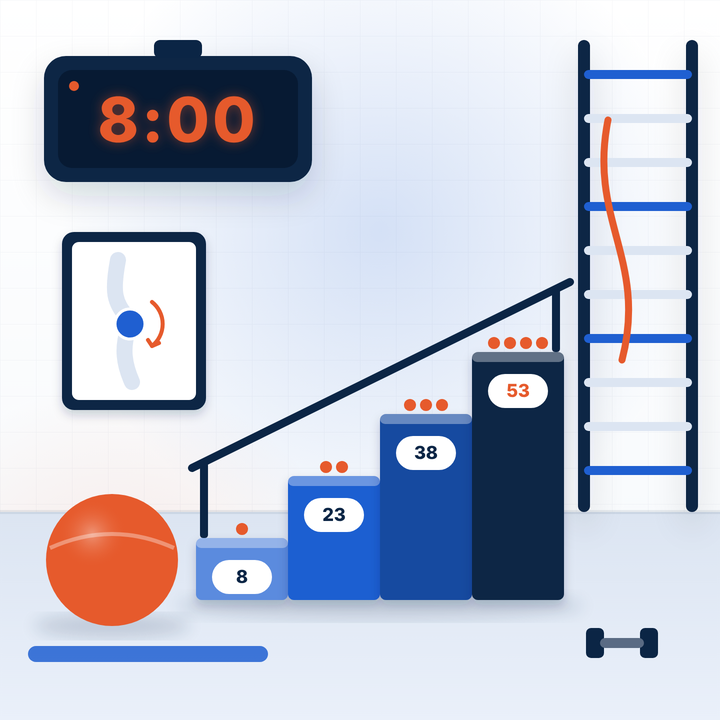
Under the rule, each new unit starts at 8, 23, 38 and 53 minutes, then every 15 minutes after that. The chart below is based on the CMS chart. Its 0 to 7 row reflects the CMS rule that a service under 8 minutes on its own is not billed.
| Total timed minutes | Units billed |
|---|---|
| 0 to 7 | 0 |
| 8 to 22 | 1 |
| 23 to 37 | 2 |
| 38 to 52 | 3 |
| 53 to 67 | 4 |
| 68 to 82 | 5 |
| 83 to 97 | 6 |
| 98 to 112 | 7 |
| 113 to 127 | 8 |
CMS expects each unit to average about 15 minutes of direct contact. A practice that routinely bills units on less time should expect those claims to draw review.
8-minute rule unit calculator
Enter the timed minutes for each code delivered in one day. Units follow CMS Chapter 5, §20.2.
Timed codesMinutes
Try a CMS example
Leave out untimed codes such as evaluations and group therapy. Each bills 1 unit on its own.
Marks show where each unit starts.
How the units were split
Medicare’s method only. Not covered: therapist and assistant splits (CQ and CO), untimed codes, and payer contracts with their own rules.
Getting every unit right is one reason practices weigh outsourcing. Is outsourcing medical billing a good idea?
Which minutes count toward the total
Only time spent directly treating the patient counts. The clock starts when the clinician begins treatment with the patient already in the treatment area. Setup, rest breaks, toileting and waiting for equipment are not treatment time, and neither is work done before or after the treatment itself.
When two clinicians treat one patient at once, the minutes count once. CMS gives the example of gait training that needs a therapist and an assistant in the parallel bars. Each 15 minutes of treatment is still 1 unit of 97116, not 2. The rule is in Chapter 5, §20.3.
Combining codes: how leftover minutes are split
Bill each full 15 minutes to its code, then give any remaining unit to the code with the most leftover minutes. The extra unit follows the leftover, which is why CMS’s Example 3 below gives it to the code with less total time. That last step is the one to check on every claim.
The four steps, following CMS’s examples:
- Total the timed minutes and read the unit count off the chart.
- Assign every full 15-minute block to its code, so no code with 15 minutes or more is left without a unit.
- Compare the minutes left over on each code and give the next unit to the largest. On a tie, bill either code, not both.
- Stop at the chart’s count. A code left without a unit still goes in the treatment note.
The four sessions below are CMS’s own examples from Chapter 5, §20.2.C.
47 minutes across two codes: 3 units.
Neuromuscular reeducation (97112) ran 24 minutes and therapeutic exercise (97110) ran 23. Each passed 15 minutes, so each gets 1 unit. The third goes to 97112, the code with more time, and its 9 leftover minutes also beat 97110’s 8.
40 minutes, uneven split: 3 units.
Therapeutic exercise ran 33 minutes and manual therapy (97140) ran 7. The first 30 minutes of 97110 make 2 units. Its 3 leftover minutes lose to the 7 minutes of 97140, which takes the third unit.
49 minutes across four codes: 3 units.
The session ran 18 minutes of 97110, 13 of 97140, 10 of gait training (97116) and 8 of ultrasound (97035). The total supports only 3 units. So 97110, 97140 and 97116 bill 1 each, and the ultrasound is documented but not billed.
21 minutes across three short codes: 1 unit.
Three codes ran 7 minutes each. None reaches 8 minutes alone, but the total does. The clinician bills 1 unit of whichever code is most appropriate.
Medical billing from Northgate Billing counts therapy units under CMS §20.2. Physical therapy claims go out within 48 hours of the visit, inside the practice’s own software.
When a PT and an assistant share the minutes: CQ and CO
A unit furnished in whole or in part by a physical therapist assistant carries the CQ modifier; an occupational therapy assistant’s carries CO. Since January 1, 2022, those units pay 85% of the otherwise applicable Medicare payment. CQ is paired with the GP modifier and CO with GO, and a claim that breaks the pairing is returned.
The split follows the same order as the 8-minute rule. Full 15-minute blocks come first, and a block the assistant furnished alone carries the modifier. The final unit is decided on its own:
- If the therapist alone furnished 8 minutes or more of it, it bills without the modifier, whatever the assistant added.
- If not, the 10% de minimis standard applies. The modifier goes on when the assistant’s minutes exceed 10% of that unit’s minutes.
One narrow exception covers two remaining units of the same code. It applies to 13 specific splits of therapist and assistant minutes, each 9 to 14 minutes and totaling 23 to 28. In those splits, one unit carries the modifier and one does not. CMS lists the 13 splits on its CQ and CO examples page.
45 minutes of 97110, split between a PTA and a PT: 3 units.
The assistant furnished 22 minutes and the therapist 23. The assistant’s first full 15 minutes bill 1 unit with CQ, and the therapist’s first 15 bill 1 unit without it. The therapist’s 8 leftover minutes carry the third unit, also without CQ. This is Example D on the same CMS page.
Medicare’s 8-minute rule vs the CPT midpoint rule
The CPT time rule counts each code on its own. A unit is billed once that code passes the midpoint of its 15 minutes, which is more than 7 minutes 30 seconds. Medicare adds the minutes first. The CPT time rule is summarized by AAFP’s Family Practice Management.
The two methods can give different counts for the same session. A session with 10 minutes of 97110 and 10 of 97140 totals 20 minutes, which is 1 unit under Medicare. Under the midpoint rule, each code passes the midpoint, so the session bills 2. It also runs the other way: three codes at 7 minutes each bill 1 unit under Medicare and none under the midpoint rule.
Which method applies is set by each payer’s policy or contract, and a contract can set its own threshold. Some billers call the per-code method the Rule of Eights, but that label is informal. Medicare Advantage plans can set their own policies, so check each plan’s rules rather than assuming Original Medicare’s.
Conclusion: counting therapy units the Medicare way
The 8-minute rule comes down to one total and one split. Total the timed minutes, find the band, then give full blocks to their codes before leftovers. A practice that rarely mixes codes in a session needs the chart, not a new process.
Practices that bill several disciplines, use assistants or work with payers on the midpoint rule have more places for a unit to go wrong. How a billing team handles that work is set out on the physical therapy billing and medical billing services pages. Northgate Billing signs a Business Associate Agreement under 45 CFR 164.504(e) before its team opens any therapy record. Once the counting is right, the open question is whether billing belongs in-house at all.
Frequently asked questions
What is the 8 minute rule in physical therapy?
It is Medicare’s method for turning timed physical therapy minutes into 15-minute billing units. A session needs at least 8 timed minutes before any timed unit can be billed. It applies to codes such as therapeutic exercise, manual therapy and gait training, but not to evaluations. In physical therapy it matters most when one visit mixes several timed codes.
What is the 8 minute rule for billing?
For billing, the 8-minute rule decides how many timed units a claim can carry for one patient on one day. The biller totals the timed minutes across codes, finds the matching band on the CMS chart, then splits the units across codes. Medicare requires it. Commercial payers may use it or the CPT midpoint rule, so each payer decides which count goes on the claim.
What is the 8-minute rule for PT billing?
In PT billing, the rule also decides which codes receive the units, not only how many. Full 15-minute blocks stay with the code that earned them. A unit left over goes to the code with the largest remainder, which is not always the code with the most total time. A payer on the midpoint rule, by contrast, rounds each code on its own.
Is 38 minutes 2 or 3 units?
Under Medicare’s 8-minute rule, 38 minutes is 3 units. The chart’s 3-unit band runs from 38 to 52 minutes, so a session at 37 minutes stays at 2. The 38 minutes are the total across every timed code that day. Under the CPT midpoint rule, the answer depends on how the 38 minutes split between codes.
Does the 8-minute rule apply to Medicare Part A?
No. The 8-minute rule governs Part B outpatient therapy billed in 15-minute units. Therapy during a covered Part A stay in a hospital or skilled nursing facility is not billed by the unit. It is paid inside the facility’s Part A payment. The rule applies again when the same patient receives therapy under Part B, such as a nursing facility resident outside a covered stay.
Does the 8-minute rule apply to group therapy?
No. Group therapy, CPT 97150, is an untimed code, so each patient in the group is billed 1 unit however long the session runs. Its minutes do not join the timed total. If the same patient also receives one-on-one timed treatment that day, only those one-on-one minutes count toward the 8-minute rule.
What does the treatment note need to show for timed codes?
Medicare requires the note to show the total timed code treatment minutes and the total treatment time, including untimed services. It does not require minutes for each intervention, though per-code minutes make a split easier to defend. Those totals are what a reviewer uses to recount the units.
Next: should billing stay in-house?
Counting units is one of the jobs that decides it. See when outsourcing pays off, and when it does not.
Read the outsourcing guideOr see medical billing services

Written by
Orvella Denvik
Senior Account Lead, Northgate Billing
This article explains Medicare billing rules in general terms. It is not coding or legal advice for a specific claim. Check each payer’s current policy before you bill.