
In this article6 sections
Key takeaways
- Paid first, filed by the patient: the patient pays the practice in full, then sends the superbill to their plan.
- Codes on every line: one Blue Cross form asks, for each line, for the date of service, procedure code, modifier, units, charge and diagnosis code.
- 2 provider numbers: the provider’s 10-digit NPI and 9-digit tax ID are both required fields on that form.
- Receipts, not invoices: the same form requires proof of payment, does not accept invoices or ledgers, and will not process an incomplete request.
- The practice stays off the claim: no contract with that plan, no claim follow-up and no insurer money owed to the practice, because the plan pays the patient.
- Original Medicare is the exception: providers must file claims for covered services themselves under Social Security Act section 1848(g)(4). Refusing can bring civil monetary penalties and exclusion.
The question “what is a superbill” usually reaches a practice through a patient. Someone pays for a session in full, then asks for paperwork their insurer will accept. If the practice does not bill that plan, the superbill is how the patient claims back part of the fee. Whether the plan pays depends on what the document carries, and on whether the practice should be issuing one at all.
The superbill route
Paid at the visit, filed by the patient, paid back by the plan
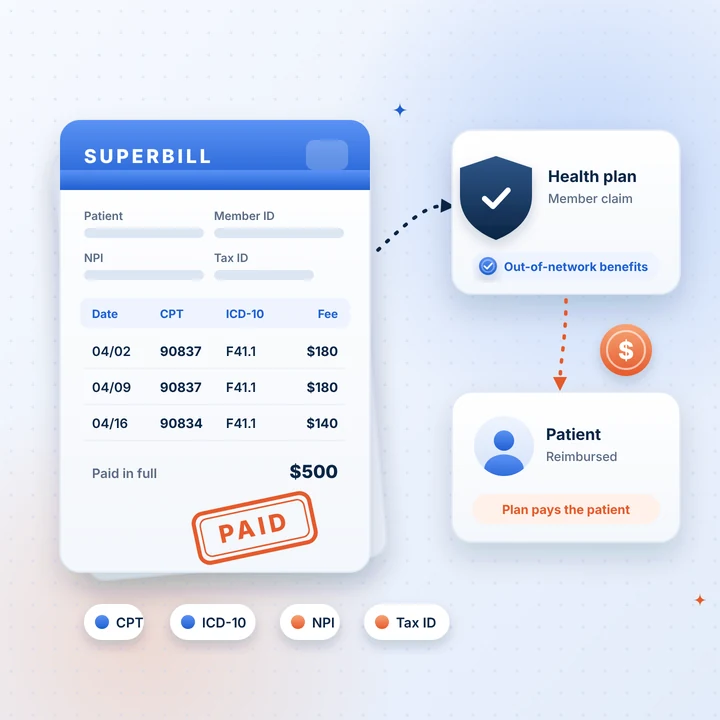
The practice is paid in full first. Everything after that is between the patient and the plan.
- 1Patient pays in fullAt the visit, at the practice's own fee
- 2Practice issues the superbillPatient, provider, visit, codes, charges and proof of payment
- 3Patient sends it to the planOn the plan's own member claim form
- 4Plan pays the patientOnly with out-of-network benefits for that service
The practice files nothing with the insurerIn-network: file the claim insteadOriginal Medicare: the provider must file
What a superbill is used for
A superbill lets a patient claim out-of-network benefits for a visit the practice has already been paid for in full.
The order is the same each time. The patient pays at the visit, the practice issues the superbill, the patient sends it to the plan, and the plan pays the patient. With a superbill, the practice files nothing with the insurer.
Practices that are out-of-network with a patient’s plan, or that take no insurance at all, issue most superbills. Therapists, chiropractors, physical therapists and dietitians all use them. For many therapists, superbills are a routine part of billing for mental health practices.
A superbill is not a claim. A claim is filed by the provider, on the CMS-1500 claim form or its electronic version. A superbill is filed by the patient.
What the patient gets back depends on their plan. The detail sits in how out-of-network billing works for providers.
What is included in a superbill
A superbill needs 5 groups of data: patient, provider, visit, codes, and charges with payment. One Blue Cross plan’s form states that requests missing required information will not be processed.
| Field group and what it holds | Why the plan needs it | What gets it sent back |
|---|---|---|
| Patient: name, date of birth, address, member ID as printed on the card | Matches the visit to the member’s policy | A member ID from an old card, or a name that differs from the policy |
| Provider: treating provider’s name and credentials, practice address, 10-digit NPI, 9-digit tax ID | Identifies who gave the care and who was paid | A missing NPI or tax ID, or an NPI the plan cannot match to the tax ID |
| Visit: a date of service on every line, place of service code | Dates set the benefit period; the place of service shows office or telehealth | One date covering several sessions; plans read each line by its own date |
| Codes: CPT or HCPCS code, modifier, units or minutes, ICD-10 code linked to each line | Tells the plan what was done and why | A diagnosis written in words with no code, or none at all |
| Charges and payment: charge per line, total, amount paid, payment date and method | The plan reimburses only what the patient paid | An invoice or balance-due statement instead of a receipt |
The NPI is a 10-position numeric identifier that HIPAA requires health plans to use for providers. Group practices should confirm whether a plan wants the treating provider’s own NPI or the group’s. Include the place of service code whenever the plan’s form asks for one.
Deciding who should file the practice’s claims? Is outsourcing medical billing a good idea?
How do I know if my insurance will take a superbill?
A plan takes a superbill when 2 things hold. The policy has out-of-network benefits for that service, and the superbill carries every field on the plan’s member claim form. Only the plan can confirm the first. The practice controls the second, and can check it before the patient files.
What the patient asks the plan
The plan’s answers to 4 questions settle it. Does the plan pay out-of-network for this service? How much of the out-of-network deductible is left? Which claim form does it use, and where does the form go? A plan without out-of-network benefits usually pays nothing toward the visit, however complete the superbill is.
What the practice matches
Each plan publishes its own member claim form. Lay the superbill out in the order the form asks for: patient, service lines, then provider numbers. When the superbill mirrors the form, the patient copies fields across instead of guessing.
When a private-pay practice should issue a superbill
Issue a superbill when the practice is out-of-network with the patient’s plan or bills no insurance at all, and the patient has paid in full.
When the practice is out-of-network or has no payer contracts
Issue the superbill: this is the case it was built for. The practice sets its own fee and is paid at the visit. The patient decides whether to file, and the plan decides what to pay back. The practice can also file the out-of-network claim itself, so the patient does not have to file.
When the practice is in-network with the patient’s plan
File the claim instead. Network agreements put claim filing on the provider. The Kaiser Permanente Northern California provider manual, for example, makes submitting itemized claims for members the provider’s responsibility. A practice that joins networks moves from handing out superbills to running claims, denials and follow-up. Northgate Billing files in-network and out-of-network claims at the same rate, inside the practice’s own software. That claim work is what medical billing services cover.
When federal law requires the provider to file
A superbill is not a route to Original Medicare payment. A provider must file the claim for covered services under section 1848(g)(4) of the Social Security Act, and cannot charge the patient for filing it. A provider who has opted out bills under a private contract, and no Medicare claim can be filed for those services.
Conclusion: when a superbill is the right tool
A superbill is the right tool while a practice stays out of network and prefers not to file claims. The trade-off is that the paperwork and the wait move to the patient. Many practices are in-network with some plans and out-of-network with others, the mix medical billing for small and group practices describes.
Superbills and claims carry the same protected health information. Northgate Billing signs a Business Associate Agreement under 45 CFR 164.504(e) before it touches any record behind a practice’s claims. Whether the practice keeps issuing superbills or starts filing claims, the next question is who does that work: the practice, or an outside team.
Frequently asked questions
Do insurance companies pay superbills?
Yes, when the patient’s plan has out-of-network benefits for the service and the deductible has been met. The payment goes to the patient, not the practice. It is often less than the fee paid, because the plan works from its own allowed amount, minus the patient’s coinsurance. A complete superbill gets the request processed; the plan’s benefits set the amount.
What is the difference between a bill and a superbill?
A bill asks for payment that is still due. A superbill records a payment already made, and adds the codes and provider numbers an insurer needs to reimburse the patient. Plans reimburse from a superbill, not from a bill, because only the superbill shows that the patient has already paid.
Does Blue Cross Blue Shield reimburse superbills?
It depends on the member’s plan. Each Blue Cross Blue Shield company is an independent licensee with its own benefits and its own member claim form. Plans with out-of-network benefits generally accept a member-submitted claim with an itemized bill and proof of payment. The member’s benefits, not the brand on the card, decide whether a superbill pays.
Will Medicare accept a superbill?
Not under Original Medicare, where the provider files the claim. If Medicare does not enroll the practitioner, the patient sends Form CMS-1490S, the itemized bill and the provider’s statement that they cannot bill Medicare. That mainly produces a denial for supplemental coverage. Medicare Advantage plans set their own claim rules, and some accept a superbill.
Does a superbill need the provider’s signature?
Requirements vary by plan. One Blue Cross member reimbursement form asks the member to sign a certification and has no field for a provider signature. Adding the treating provider’s signature or e-signature costs nothing and answers any plan that asks for one. The plan’s own claim form is the final word on what the superbill must carry.
Can a patient use a superbill for HSA or FSA reimbursement?
Usually, yes. IRS Publication 969 says an FSA needs an independent third party’s written statement of the expense and its amount. A superbill showing the date, service and amount paid is that record. HSA owners must keep records showing the money paid qualified medical expenses. If an insurer has already reimbursed part of the visit, only the rest of the superbill’s amount can be claimed from the account.
Is a superbill the same as an encounter form?
The names overlap. AAPC uses superbill and fee ticket as other names for the encounter form. That form tells billing staff what was done at a visit and why. In private-pay practices, superbill usually means the patient-facing document covered here. The difference is the reader: the practice’s own billing staff, or the patient’s insurer.
Filing superbills now?
See when keeping billing in-house makes sense, and when it does not.
Is outsourcing medical billing a good idea?Or start with a free billing audit.

Written by
Orvella Denvik
Senior Account Lead, Northgate Billing
This article is general information about billing practice, not legal or tax advice. Plan rules vary, so check the patient’s plan documents before relying on any point here.