
In this article9 sections
- 01Mental health CPT codes by family
- 02Diagnostic evaluations: when 90791 applies
- 03Psychotherapy CPT codes and their time windows
- 04Family and group psychotherapy codes
- 05Crisis services: 90839, 90840 and the 30-minute floor
- 06Interactive complexity: when 90785 applies
- 07Conclusion: picking the right mental health code
- 08Frequently asked questions
- 09In-house or outsourced?
Key takeaways
- Intake and therapy cannot share a date: 90791 and 90792 are not billed on the same date as 90832 to 90838 or an E/M visit by the same provider.
- Crisis care starts at 30 minutes: 90839 covers 30 to 74 minutes. One unit of 90840 is added at 75 minutes and a second at 105.
- Crisis codes stand alone: Medicare does not allow 90839 or 90840 for the same date as 90791, 90792, 90785 to 90899 or 90832 to 90838.
- Crisis care at home bills as G0017 and G0018: the same applies in other non-facility settings except the office. Medicare pays them at 150% of the non-facility fee schedule amount.
- 90785 needs a qualifying factor: one of four communication complications must be documented, and the code never goes with crisis care.
- 90791 marks the start of care: one Medicare contractor allows a repeat in five cases, including a break of about 6 months without treatment.
Every therapy claim carries a CPT code, and the code has to match what happened in the session. That means who was in the room, how long it ran, and whether it was a crisis. Mental health CPT codes follow a short set of rules. A wrong pick still sends the claim back. This guide covers which code fits each kind of session, how much time each one needs, and which codes cannot share a claim.
Mental health CPT codes by family
Every mental health CPT code belongs to one of four families: diagnostic evaluation, psychotherapy, crisis care and add-ons. Most families have a time floor, and each has codes it cannot share a claim with. The table puts both side by side.
| Code and service | Time floor | Cannot be billed with |
|---|---|---|
| 90791, diagnostic evaluation, no medical services | Not timed | An E/M visit or 90832 to 90838 by the same provider on the same date; 90839, 90840 |
| 90792, diagnostic evaluation with medical services | Not timed | An E/M visit or 90832 to 90838 by the same provider on the same date; 90839, 90840 |
| 90832, psychotherapy, 30 minutes | 16 to 37 min | 90791, 90792 or an E/M visit by the same provider on the same date (with E/M, use +90833); 90839, 90840 |
| 90834, psychotherapy, 45 minutes | 38 to 52 min | 90791, 90792 or an E/M visit by the same provider on the same date (with E/M, use +90836); 90839, 90840 |
| 90837, psychotherapy, 60 minutes | 53 min or more | 90791, 90792 or an E/M visit by the same provider on the same date (with E/M, use +90838); 90839, 90840 |
| 90846, family psychotherapy, patient absent | 26 min | 90839, 90840 |
| 90847, family psychotherapy, patient present | 26 min | 90839, 90840 |
| 90853, group psychotherapy | Not timed | 90839, 90840 |
| 90839, psychotherapy for crisis, first 60 minutes | 30 to 74 min | 90791, 90792, 90785 to 90899, 90832 to 90838 |
| +90840, crisis, each additional 30 minutes | From 75 min | Same as 90839; never billed without it |
| +90785, interactive complexity | Not timed | 90839, 90840; an E/M visit with no psychotherapy |
A code pays only when the provider is enrolled with the payer, or the plan pays out-of-network benefits. For in-network billing, insurance credentialing for therapists comes first. Collaborative care codes (99484 and 99492 to 99494) follow rules of their own, and so do testing and screening codes. See psychological testing billing and billing CPT 96127 for screening.
Diagnostic evaluations: when 90791 applies
90791 is the intake code: a psychiatric diagnostic evaluation without medical services, billed once at the start of care. It covers the history, a mental status exam and the recommendations that set up treatment. Under CPT, the code is not timed, so a long intake and a short one bill the same way. Some Medicaid programs bill it in time units instead. It is reported once per day. It is not billed on the same date as an E/M visit or any psychotherapy, crisis included, by the same provider.
When 90791 can be billed again
WPS, the Medicare contractor for several Midwest states, lets the same provider bill 90791 again in five cases:
- The patient returns after an extended break, which WPS puts at about 6 months without treatment.
- The patient has been admitted as an inpatient for a psychiatric illness.
- The patient’s mental status has changed significantly.
- A patient with an established neurological disorder or dementia has an acute change in mental status.
- A second opinion or diagnostic clarification is needed.
Other payers set their own limits, so check the payer’s policy before billing a second intake.
90792 is the same evaluation with medical services added, such as a physical exam or prescribing. Only prescribers bill it.
Time windows
Which code the session length lands on
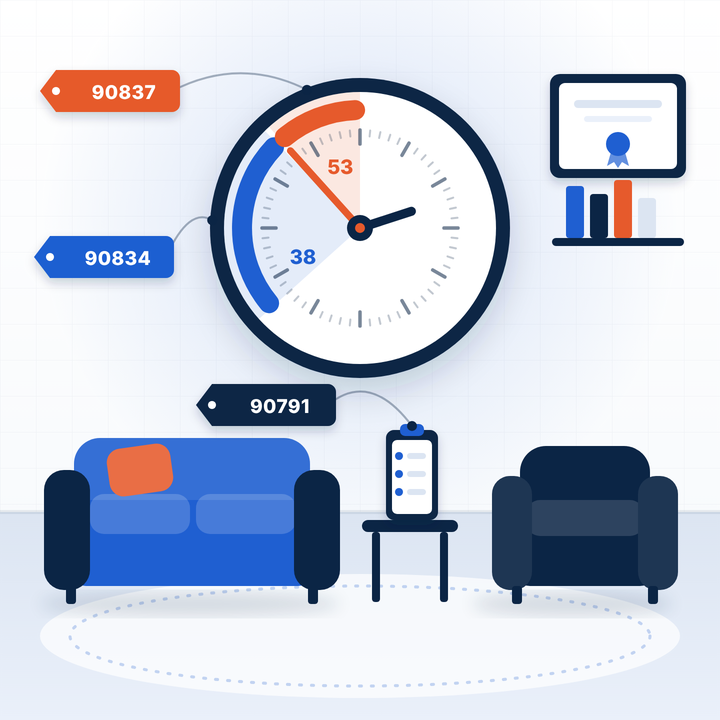
Psychotherapy is coded by face-to-face time. Crisis care has its own scale.
Individual psychotherapy
Crisis psychotherapy
90791 intake never shares a date with 90832 to 90838Crisis codes stand alone
Psychotherapy CPT codes and their time windows
Individual psychotherapy is coded by face-to-face time: 90832 for 16 to 37 minutes, 90834 for 38 to 52, and 90837 for 53 or more. Each session goes to the code whose named length is closest to the time spent, so a 40-minute session is 90834, not 90832. Time counts the minutes spent in therapy with the patient, with or without a family member in the room.
A session under 16 minutes is not reported with any psychotherapy code, as Noridian’s Medicare mental health guidance states. Psychoanalysis has its own code, 90845, which is not timed. Billing two units of 90837 for a long session is a separate question, covered in choosing between 90837 and 90834.
With a medication visit
A prescriber who manages medication and provides therapy in the same visit bills an E/M code plus an add-on: +90833, +90836 or +90838. The add-on uses the same time windows and counts therapy minutes only. Whether 99214 and 90834 can share a claim is answered in billing psychotherapy with an E/M visit.
By video
The same codes apply when the session runs by video. Payers set their own telehealth rules for the place-of-service code and any modifier, and telehealth CPT codes for therapists sets out which ones.
Family and group psychotherapy codes
Family therapy uses 90846 or 90847, depending on whether the patient is in the room, and group therapy uses 90853. The difference comes down to who the other people are. When they are one patient’s family, a family code applies. When they are separate patients working together, it is group therapy.
Both family codes are named as 50-minute services and need at least 26 minutes, as the San Francisco DPH CPT tip sheet sets out. Same-day rules and coverage questions are covered in billing couples and family therapy.
90853 is billed once for each patient in the group, on that patient’s own claim. CPT attaches no time to it, so a 60-minute group and a 90-minute group bill the same code. When one member’s participation is complicated by a communication factor, +90785 goes on that member’s claim only, not on every claim from the session. 90849 covers multiple-family group psychotherapy, where several families are treated together.
Crisis services: 90839, 90840 and the 30-minute floor
90839 covers the first 30 to 74 minutes of psychotherapy for a patient in crisis. 90840 adds 30 minutes at a time from minute 75. The code descriptor says “first 60 minutes”, but the CPT time rule stretches the first unit both ways. When the two disagree, the time rule decides the code.
What counts as a crisis
The codes are for a patient in high distress with a complex or life-threatening problem that needs immediate attention. Under CMS’s psychotherapy for crisis guidance, the service includes an urgent assessment of the crisis state, a mental status exam and psychotherapy. It also covers mobilizing resources to restore safety and interventions that limit psychological trauma.
How crisis time adds up
Crisis codes are chosen by the total crisis minutes on the date of service, and 90839 is reported once for that date. The San Francisco Department of Public Health’s CPT tip sheet and AAPC coding guidance give these thresholds:
- 16 to 29 minutes: not a crisis code. Report 90832, or +90833 when a prescriber also bills an E/M visit. Under 16 minutes, no psychotherapy code applies.
- 30 to 74 minutes: 90839 alone.
- 75 to 104 minutes: 90839 plus one unit of 90840.
- 105 to 134 minutes: 90839 plus two units of 90840.
Illustrative example: a 70-minute crisis session is billed as 90839 alone. An 80-minute session is 90839 plus one unit of 90840. Adding 90840 to the 70-minute session is an error, because 90839 already reaches 74 minutes.
Crisis codes also stand alone: CMS bars them on the same date as any evaluation, psychotherapy or add-on code in the table’s crisis row. Northgate Billing submits crisis psychotherapy claims within 48 hours of the visit.
Crisis care outside the office: G0017 and G0018
Crisis psychotherapy at the patient’s home is billed with G0017 and G0018 in place of 90839 and 90840. The same goes for other settings paid at Medicare’s non-facility rate, apart from the office. G0017 covers the first 60 minutes and G0018 each additional 30 minutes. Medicare pays them at 150% of the non-facility fee schedule amount. In the office, and in hospitals and other facilities, the standard crisis codes still apply.
Interactive complexity: when 90785 applies
90785 is added to an evaluation, psychotherapy or group code when one of four communication factors complicated the session. It attaches to 90791, 90792, 90832 to 90838 or 90853, and it is never billed on its own. The factor has to be named in the note, along with how it affected the session.
The four factors are:
- Maladaptive communication: managing high anxiety, high reactivity, repeated questions or disagreement among the people in the session.
- Caregiver interference: a caregiver’s emotions or behavior get in the way of understanding or carrying out the treatment plan.
- Sentinel event: the patient discloses an event such as abuse or neglect. A mandated report goes to a third party, and the session covers it.
- Play or devices: play equipment or another physical device is needed to communicate with a patient who lacks, or has lost, typical language skills.
90785 never goes with 90839 or 90840. It is also left off an E/M visit when no psychotherapy was billed with it. The add-on describes extra work inside the therapy, not the medical visit.
Conclusion: picking the right mental health code
Most mental health claims turn on three checks: the minutes, the 30-minute crisis floor, and the codes that cannot share a date.
A solo practice billing mostly 90834 and 90837 can usually run these checks in-house. No billing team can fix a note that does not support the minutes billed. Northgate Billing signs a Business Associate Agreement under 45 CFR 164.504(e) before it opens any therapy practice’s records. How outsourced billing works for therapy practices is set out under mental health and behavioral health billing and medical billing services. Run on every claim, every week, these checks leave one question: whether the work belongs in-house or with a billing team.
Frequently asked questions
Is CPT 99214 a mental health code?
No, 99214 is not a psychotherapy code. A psychiatrist, nurse practitioner or other prescriber may bill it for a medication visit, which is medical care rather than therapy. The psychotherapy codes in this guide, 90832 to 90837, are a separate family. They are chosen by therapy minutes, not by how complex the visit was.
What are CPT codes for mental health?
CPT codes for mental health are the five-digit codes that describe the service on a therapy or psychiatry claim. The core set starts with 90791 and 90792 for evaluations and 90832, 90834 and 90837 for individual psychotherapy. Family therapy uses 90846 and 90847, groups use 90853, and crisis care uses 90839 and 90840. Add-ons such as 90785 describe extra work within a session.
What is the difference between a CPT code and an ICD-10 code?
A CPT code says what the provider did, and an ICD-10 code says why. On a therapy claim, 90834 might describe a 45-minute session, while F41.1 records generalized anxiety disorder as the reason for it. Payers check that the two fit together, so a correct psychotherapy code still needs a diagnosis that supports the service.
Does crisis psychotherapy time have to be continuous?
No. CMS lets providers count crisis psychotherapy time across the date of service even when it is not continuous. A provider might spend 45 minutes with a patient in crisis in the morning and 45 more that afternoon. Those minutes add up to 90, which is billed as 90839 plus one unit of 90840.
Can 90785 be billed because an interpreter joined the session?
No. CMS guidance says 90785 generally should not be billed solely because an interpreter or translator was used. Doing so may conflict with federal law. Interactive complexity needs one of the four communication factors CPT lists. An interpreter can be present in a session that meets one of those factors, and only that factor supports the add-on.
Are 90885, 90887 and 90889 paid separately?
Medicare treats all three as bundled services nationally. They carry status B on the Medicare fee schedule, so they are not paid on their own and cannot be billed to the patient. They cover record review, explaining results to family, and reports. Many commercial payers follow the same rule. Some Medicaid programs pay for them, so the payer’s policy decides whether they belong on a therapy claim.
Is HCPCS the same as CPT?
Not quite. CPT codes, written by the American Medical Association, are Level I of HCPCS, the wider national code set. HCPCS Level II adds codes that start with a letter, such as G0017 for crisis care at the patient’s home, and the H-codes many Medicaid programs use for behavioral health. A therapy claim can carry either kind, depending on the payer and the service.
In-house or outsourced?
The next guide weighs what billing costs a practice either way.
Is outsourcing medical billing a good idea?Or start with a free billing audit.

Written by
Orvella Denvik
Senior Account Lead, Northgate Billing
This article explains general coding rules. It is not legal advice or a coding decision for a specific claim. Payer policies change, so check the payer’s current policy before billing.